Need help?
Do you have a question about the digico D5T and is the answer not in the manual?
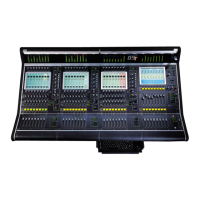
Overview of the D5T console's hardware, including worksurface and rack units.
Details on connecting the console and its components using MADI and optical fibre.
Introduction to basic console functions, controls, and initial setup steps.
Panel for creating new sessions, defining buss modes, and clearing settings.
Managing system connections between consoles, racks, and external devices.
Process for assigning input signals to channels via fader banks.
How to route channel signals to Sub Groups and Direct Outputs.
Routing Master, Sub Group, and Auxiliary busses to output sockets.
Procedure for saving current session configuration under a new filename.
Details on the console's four-band parametric and hi-pass/low-pass EQ filters.
Configuration and use of the compressor and gate modules.
Managing auxiliary sends, pans, and pre/post settings for channels.
Linking channels to control groups for simultaneous operation.
Setup and adjustment of console monitoring and solo functions.
Overview of console's input channels, assignment, and worksurface layout.
Soft assignment of audio input channels to console faders.
Description of individual channel controls like mute, LCD, rotaries, and labels.
Explanation of the abbreviated on-screen channel view and its controls.
Process for selecting channels to adjust EQ, Dynamics, or use the Joystick.
How to view and access detailed processing modules for a selected channel.
Detailed controls for channel label, signal group, and source selection.
Storing and recalling complete channel setups or specific parameters.
Configuration of parametric filters and high-pass/low-pass filters in the EQ module.
Explanation of compressor and gate controls, sidechain, and key signals.
Controls for channel panning, auxiliary sends, and pre/post settings.
Overview of how signals are routed to SubGroups, Direct Outputs, and other destinations.
Assigning and using dedicated buttons for channel functions like Solo, Safe, and Fader Assigns.
Linking channel controls to be adjusted simultaneously.
Configuring and managing console screen layouts and external monitor displays.
Displaying master, subgroup, and auxiliary buss levels and controls.
Overview of how buss outputs are displayed on the Master Screen.
Managing labels, controls, routing, and meters for output busses.
Overview of the 32x32 matrix for routing and processing signals.
Description of the Master section's output controls and meter bridge.
Overview of information displayed on the Master Screen.
Accessing system information and options via menu buttons.
Console operation modes (Setup, Live, Unattended) and password protection.
Managing system connections and device states in the Consoles & Racks panel.
Setting up bussing formats, channel configurations, and managing sessions.
Accessing file management functions for console sessions.
Panel for creating new sessions, defining buss modes, and clearing settings.
Loading previously saved console sessions from storage.
Saving current session configuration under a new filename.
Loading, saving, renaming, and deleting channel, EQ, and dynamics presets.
Setup and adjustment of console monitoring and solo functions.
Procedures for recovering session data after a system crash or power failure.
Configuring and using the console's talkback microphone and channels.
Linking channels to control groups for simultaneous operation.
Setting up timecode sources, frame rates, and machine control.
Configuring system synchronization using word clock, AES/EBU, or audio signals.
Storing and recalling entire console settings as Cues for performances.
Using external software for advanced cue list programming.
Recording and playback of console control movements in real time.
Configuring automation behavior like Touch Record, Auto Nulling, and Safe Mode.
Viewing and editing recorded automation events in a timeline format.
Selecting and assigning effects modules, reverbs, delays, and other processing.
Adjusting parameters for configured effects and output processing.
Common operational issues and their solutions, including gain control and routing problems.
Introduction to the D5TC's remote control interface and functions.
Guidelines for setting up systems with multiple consoles and redundant engines.
Using a PC or laptop for offline session preparation or remote console control.
 General
| Brand | digico |
|---|---|
| Model | D5T |
| Category | Music Mixer |
| Language | English |

 To Next Page