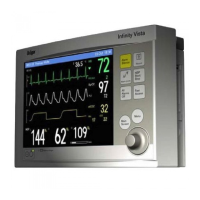
10-2 Infinity Vista VF6
10 ST SEGMENT ANALYSIS
Overview
The monitor provides an option for ST segment analysis, available for the adult and
pediatric monitoring modes. When activated, this option analyzes the patient’s normal
QRS pattern and determines values for ST segment deviation (i.e., how far the ST
segment of the QRS complex is above or below the isoelectric line). ST segment
analysis is performed on the two leads selected for ECG monitoring. The default leads
for ST analysis are lead II and V (with a 5- or 6-lead cable), the same default leads
assigned for Arrhythmia monitoring. Upper and lower limits are user-selectable and
the monitor triggers an alarm in case of limit violation.
When you connect the monitor to a patient, the monitor begins the process of learning
the patient’s dominant ECG beat pattern: this pattern serves as a baseline for
determining subsequent normal beats. The monitor stores an average ST complex that
is derived from those beats classified as normal. In order to obtain an ST segment
deviation value, the monitor then compares the isoelectric and the ST segment level of
the average complex. The ST segment deviation represents the difference in voltage
between the isoelectric and the ST segment level of the average complex. The monitor
displays the ST segment deviation in the ST parameter box. The value is updated
every 15 seconds.
NOTE:
z You can initiate a Relearn of the ECG reference pattern manually at any time
(see the chapter Arrhythmia).
z ST deviation values are displayed in mm (default) or mV. Changing the units of
measurement is a password-protected function. For information, contact your
Biomedical personnel.
WARNING: The ST algorithm has been tested for the accuracy
of detecting ST segment deviations. The significance of the
ST segment deviations must be determined by a clinician.



 To Next Page