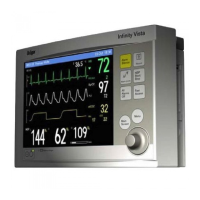
13-2 Infinity Vista VF6
13 NON-INVASIVE BLOOD PRESSURE
Overview
The monitor can acquire and process non-invasive blood pressure (NBP) signals and
display the results. Blood pressure measurements are determined by the oscillometric
method and are equivalent to those obtained by intra-arterial methods, within the
limits prescribed by the Association for Advancement of Medical Instrumentation,
Electronic Automated Sphygmomanometers (AAMI/ANSI SP-10).
If the pulse signal is poor due to patient movements, improper cuff placement or noise
in the signal, the cuff deflates and the monitor attempts a second measurement. For
causes and possible remedies for a poor pulse signal see the alarm message tables in
the chapter Alarms and Messages.
The monitor displays the systolic, diastolic, and mean pressure values in the NBP
parameter box (mmHg or kPa). You can select an enlarged NBP display in the bottom
channel of the main screen display. For more information, see the section Main Screen
Configuration in the Monitor Setup chapter.
At the end of each NBP measurement, the NBP cuff deflates to a pressure of 10
mmHg or less (adult and pediatric modes), or to a pressure of 5 mmHg (neonatal
mode). A time stamp in the NBP parameter box indicates the time of the last NBP
measurement.
WARNING: Before non-invasive blood pressure monitoring,
please read the safety information in the section NBP Safety
Considerations, below.
WARNING: Before monitoring neonates and infants:
z Select the appropriate cuff size for your patient.
z Select the neonatal or pediatric patient category in the
Patient Admit menu. This protects neonates, infants,
and pediatric patients from high cuff pressures used
for adults.
z Select the proper Inflation Mode (Neo 140 or Pediatric
180).
NOTE: Dräger recommends NBP calibration checks as part of regular monitor
maintenance and whenever the accuracy of measurement values is in doubt. NBP
calibration checks should be performed by qualified technical personnel. See the
appendix Default Settings and Biomedical Support for a description of the NBP
calibration check. For detailed calibration instructions, refer to the Service manual.



 To Next Page