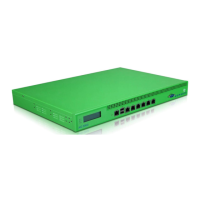
HOTSPOT GATEWAY
Glossary of Terms 337
Router
A hardware device that connects two or more networks and routes the incoming data packets to the
appropriate network.
RTS (Length)
(Request to Send) A packet sent when a computer has data to transmit. The computer will wait for a CTS
(Clear To Send) message before sending data. The RTS Length value should remain at its default setting
unless you encounter inconsistent data flow. Only minor modifications to this value are recommended
SLIP
(Serial Line Internet Protocol) SLIP is a standard protocol for connecting to the Internet with a modem
over a phone line. It has trouble with noisy dial-up lines and other error-prone connections, so look to
higher-level protocols like PPP for error correction.
SMTP
(Simple Mail Transfer Protocol) A standard protocol that regulates how e-mail is distributed over the
Internet. See also, Protocol.
SNMP
(Simple Network Management Protocol) A standard protocol that regulates network management over the
Internet. SNMP uses TCP/IP to communicate with a management platform, and offers a standard set of
commands that make multi-vendor operability possible. SNMP uses a standard set of definitions, known as
a MIB (Management Information Base), which can be supplemented with enterprise-specific extensions.
See also, TCP/IP and MIB.
Socket
A communication path between two computer programs, not necessarily running on the same machine.
Sockets are managed by a “socket device driver” that establishes network connections, as needed.
Programs that communicate through sockets need not know anything about how the network functions.
Solution Provider
Vendors are considered to be solution providers when they provide products and/or services that meet their
customer’s specific needs. Normally, a solution provider is offering a solution that isn’t readily available on
the open market. For example, NOMADIX™ is a solution provider to its customers (broadband network
service providers), and those customers are solution providers to their end users (network subscribers).
SSID
(Service Set Identifier) A 32-character unique identifier attached to the header of packets sent over a
WLAN that acts as a password when a mobile device tries to connect to the BSS. The SSID differentiates
one WLAN from another, so all access points and all devices attempting to connect to a specific WLAN
must use the same SSID. A device will not be permitted to join the BSS unless it can provide the unique
SSID. Because an SSID can be “sniffed” in plain text from a packet it does not supply any security to the
network. An SSID is also referred to as a “network name” because essentially it is a name that identifies a
wireless network.
SSL
(Secure Sockets Layer) A protocol developed by Netscape for transmitting private documents via the
Internet. SSL works by using a private key to encrypt data that is transferred over the SSL connection.
Both Netscape Navigator and Internet Explorer support SSL, and many Web sites use the protocol to
obtain confidential user information, such as credit card numbers. See also, Protocol.



 To Next Page