HOTSPOT GATEWAY
System Administration 115
Defining the RADIUS Client Settings {RADIUS Client}
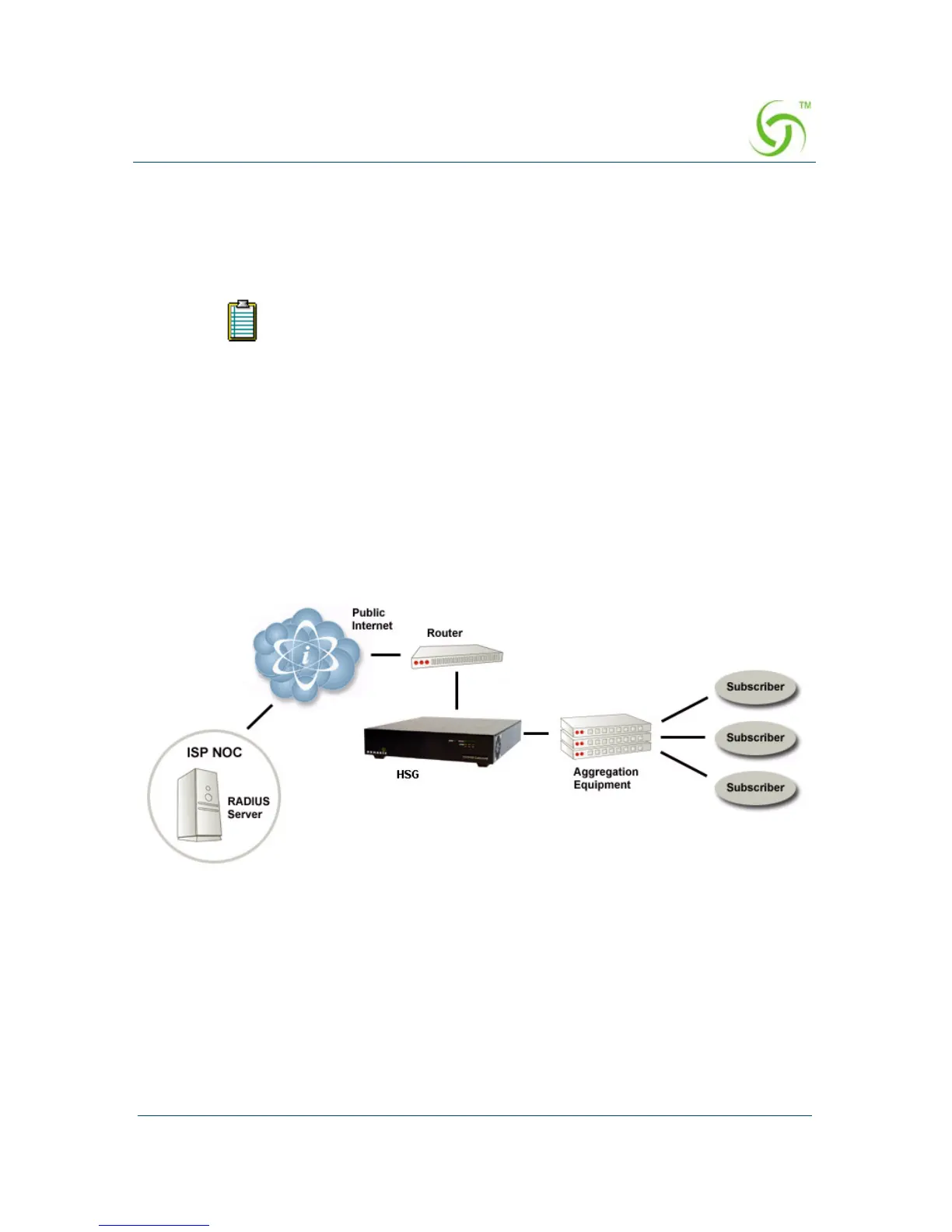
The HSG supports Remote Authentication Dial-In User Service (RADIUS).
RADIUS is an authentication and accounting system used by many Internet Service
Providers.
Nomadix offers an integrated RADIUS client, allowing service providers to track or
bill users based on the number of connections, location of the connection, bytes sent
and received, connect time, etc. The customer database can exist in a central
RADIUS server, along with associated attributes for each user. When a customer
connects into the network, the RADIUS client authenticates the customer with the
RADIUS server, applies associated attributes stored in that customer's profile, and
logs their activity (including bytes transferred, connect time, etc.).
The HSG's RADIUS implementation also handles vendor specific attributes (VSAs),
required by WISPs that want to enable more advanced services and billing schemes,
such as a per device/per month connectivity fee.
For additional RADIUS information, see also:
z “Defining the RADIUS Proxy Settings {RADIUS Proxy}” on page 118.
z “Defining the Realm-Based Routing Settings {Realm-Based Routing}” on
page 121.
z “RADIUS Attributes” on page 276.
The “Usernames” function must be enabled for a RADIUS login. See
also, “Defining the AAA Services {AAA}” on page 60.
All subscribers attempting to gain access to
the network are validated by RADIUS.



 To Next Page