Chapter 7 SCPI
The communication-related subsystems
WCDMA Options Version 6.20
229
The status subsystem provides in-depth information about the internal status of
the test set. Furthermore, powerful event processing tools allow any form of flex-
ible control over the 4400.
However, the use of the status subsystem is a bit tricky because of the many
parameters involved. Therefore, we kindly suggest to carefully read subsection
“Understanding the STATus subsystem” on page 229 before using the status
subsystem.
A table of all registers implemented can be found in subsection “Table of regis-
ters” on page 232.
Understanding the STATus
subsystem
The STATus subsystem is intended to deal with special events occurring inside the
test set. It provides tools to enable any current condition to raise a system event.
These system events may then be used to trigger service requests (SRQ) on GPIB,
or to trigger RAPID! programs.
There are several groups of registers, structured in a hierarchical order.
Lower-level registers work on specific conditions and single parameters while
higher-level registers integrate the result of several lower-level registers and
thus provide a more general view.
The highest level of these registers is the service register, sometimes also
referred to as the statusbyte register or status byte.
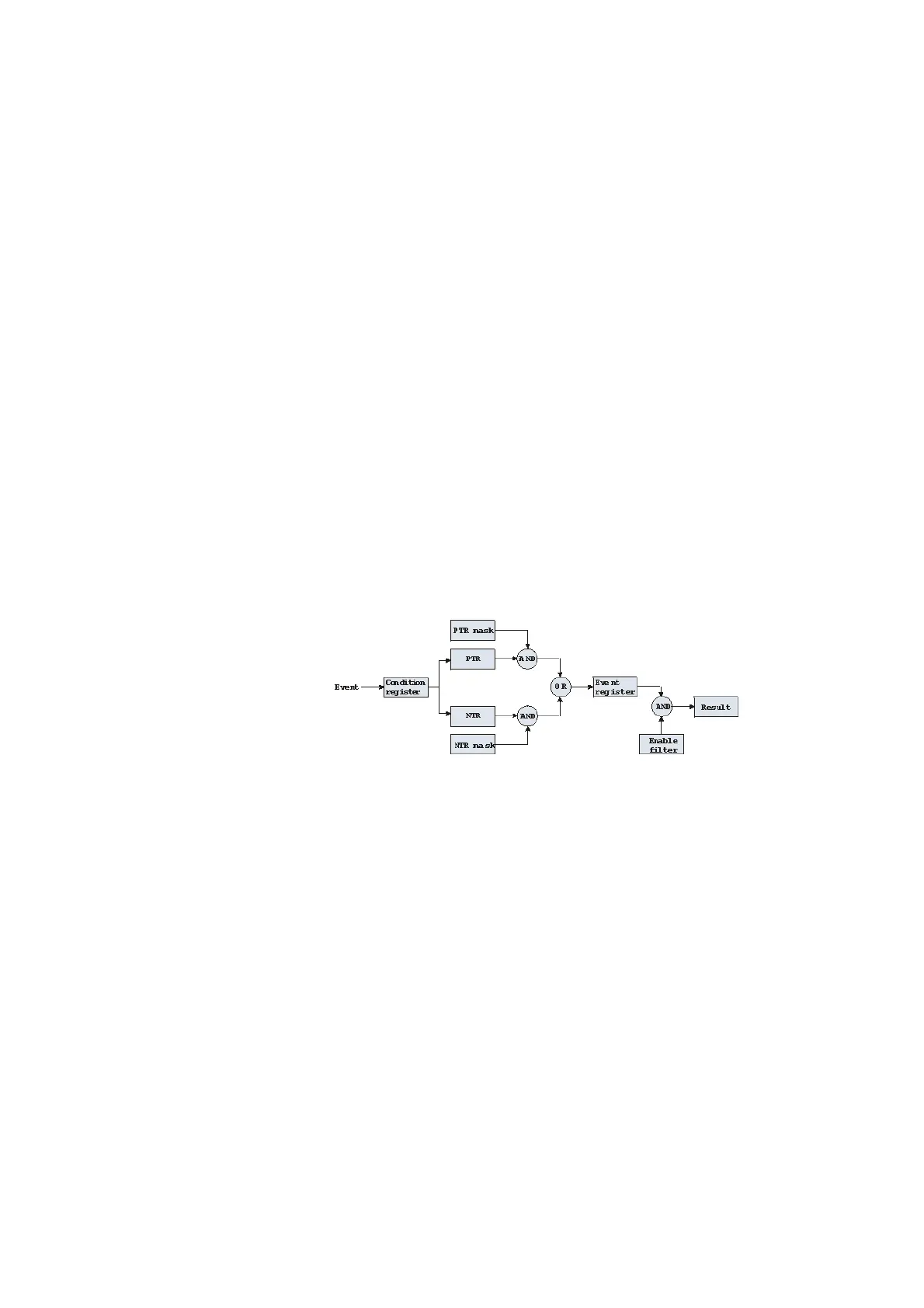
The figure below gives an example of a group of registers.
A group of registers starts with a Condition register. An internal Event will set
the corresponding bit of the Condition register (to 'set a bit' means a transition
from binary
0 to a binary 1). Any Condition register will be updated continuously.
This means that a bit will be reset as soon as the condition which rose that bit is
no longer valid.
Example:
As soon as the 4400 starts to page a mobile under test, a certain bit of a certain
condition register will be set. When the 4400 stops paging the mobile (because
e.g. it responded to the paging requests), this bit will be reset. Now, there is no
chance to find any evidence for a paging process in this Condition register.
Therefore, there is an Event register included in every group of registers. In the
Event register, a bit will remain set even when the condition for it to be set is no
longer valid. Any Event register, however, will be cleared after a query.


 To Next Page