CHAPTER 5 REFERENCE GUIDE
EFD1000/500 MFD Pilot’s Guide
Page 5-58 091-00006-001 REV B
EFD1000/500 MFD Pilot’s Guide
Page 5-59091-00006-001 REV B
5.3.2. Trac (optional)
When the EFD1000/500 MFD is congured with one of the following trac sensors the
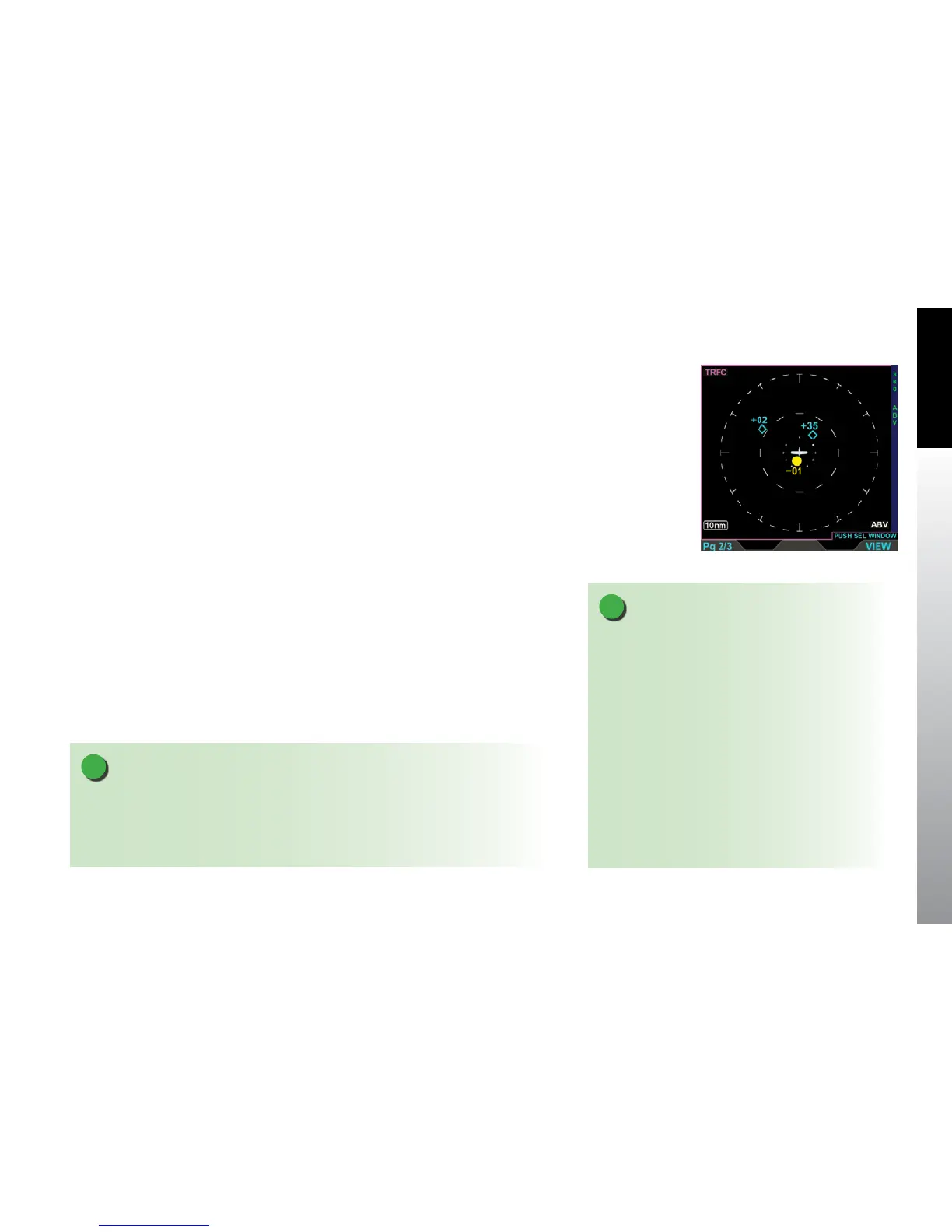
EFD1000/500 MFD can display trac information. The map is oriented North-Up on a
black background (Figure 5-71).
• Avidyne TAS 600/610/620 (TAS)
• Bendix/King KMH 880 (TAS)
• Bendix/King KTA 870 (TAS)
• Garmin GTX 330 (TIS)
• RYAN 9900BX (TAS)
• SKYWATCH SKY 497 (TAS)
• SKYWATCH SKY 899 (TAS)
TAS systems use an airborne interrogator with a half-second update rate; coverage
follows the aircraft. The TIS system uses a GTX transponder with a ve-second update
rate; coverage is limited to specic areas listed in the Aeronautical Information
Manual (AIM).
Figure 5-71
Dedicated Hazard
Awareness – Trac
NOTE
Do not rely on the EFD1000/500 MFD as the sole
source of data for collision avoidance. It is the pilot’s
responsibility to visually acquire other aircraft for
safe ight. Maneuver your aircraft based only on ATC
guidance or positive acquisition of conicting trac.
Trac information is:
• Provided as a proximity warning only
• To assist the pilot in the visual acquisition of
intruder aircraft
• Does not provide recommended avoidance
maneuvers
• Not provided for aircraft that are not transponder
equipped, experiencing a transponder failure, or
aircraft out of radar coverage
NOTE
Refer to your trac sensor’s Pilot Guide for detailed information about the sensor’s
limitations and operational ranges. Additionally, see the Aeronautical Information
Manual section titled “Trac Information Service (TIS)” for detailed information about TIS
requirements, capabilities, and limitations.


 To Next Page