v2.13 Cleverscope CS300 Reference Manual
©Cleverscope 2004-2018 www.cleverscope.com Page 129
19.3 Maths Equation Builder Walkthrough
The mathematical functions are useful for visualising information that can be derived from the measured signals.
This section describes deriving first the differential voltage across a resistor, followed by conversion of that value
to a current, then using a multiply to derive power, and finally by integrating the power to measure energy.
Derivation is very useful in a number of other areas – for example using I and Q signals to demodulate base
band signals, using 4 quadrant multiplication to simulate modulation and investigate the resulting signal
bandwidth, using filters to estimate what the real world measurement of a conditioned sensor might be.
19.4 Example - Power Consumption [Maths]
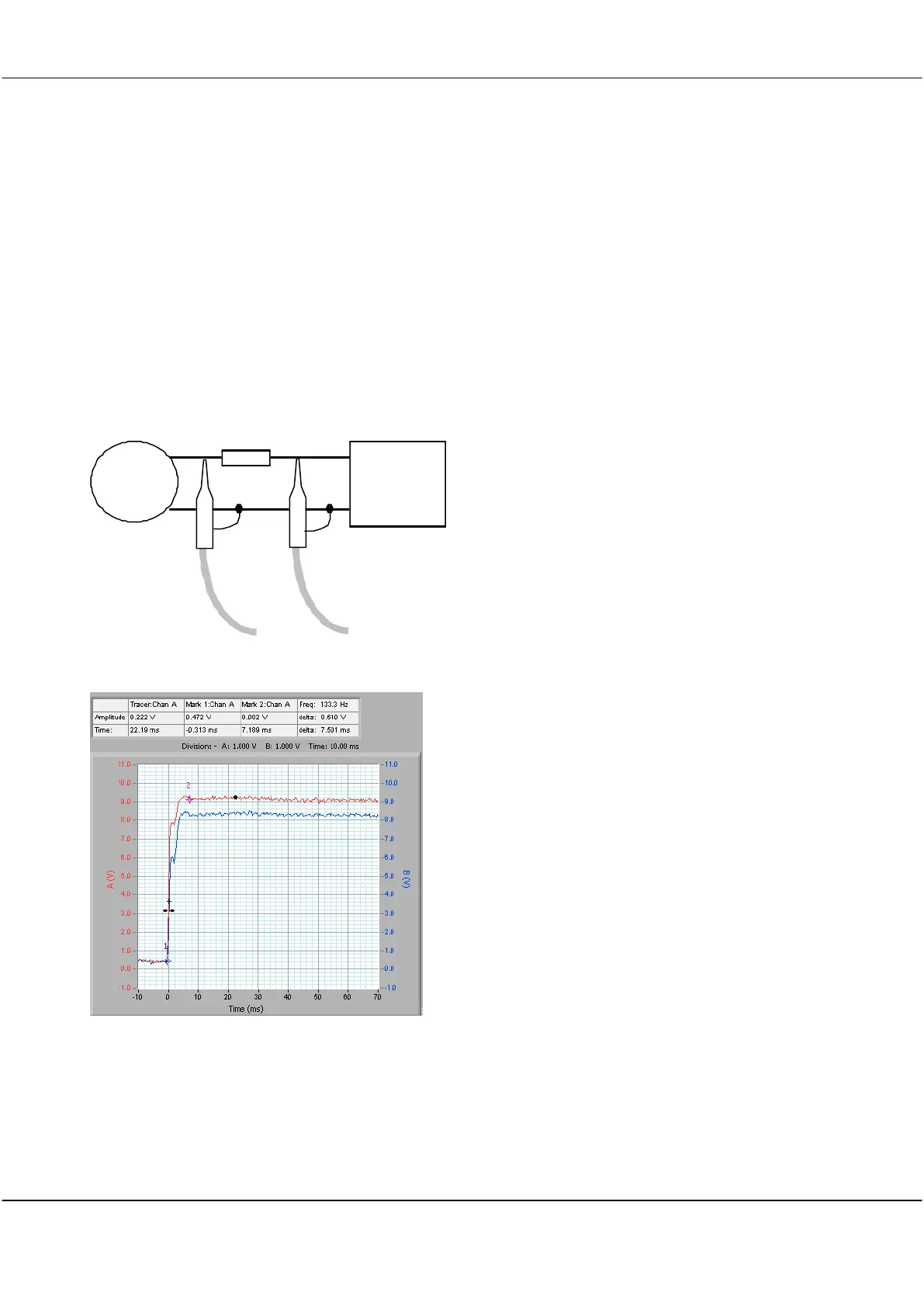
A typical power supply delivers 9V to a battery powered Unit Under Test (UUT). Our goal is to measure current,
and power consumption, and arrive at the total energy needs of the unit. To do this we use a series resistor (it
could be a DC capable current clamp) to measure the current. Because the resistor is in the positive line we need
to do differential measurements to see the current.
A – Channel A input, B - Channel B input
Here is the graph captured from a typical UUT starting up, configured as in the diagram above.



 To Next Page