v2.13 Cleverscope CS300 Reference Manual
©Cleverscope 2004-2018 www.cleverscope.com Page 53
5.3.10 Averaging.(Ctrl+A) [Settings Menu]
Averaging can be used with either the Spectrum Display or the Scope Display/Tracking Display.
A number of frames can be arithmetically averaged together to reduce the effect of
noise.
Averaging is usually used to minimize the effects of noise and to find the average
value of a signal in the presence of noise.
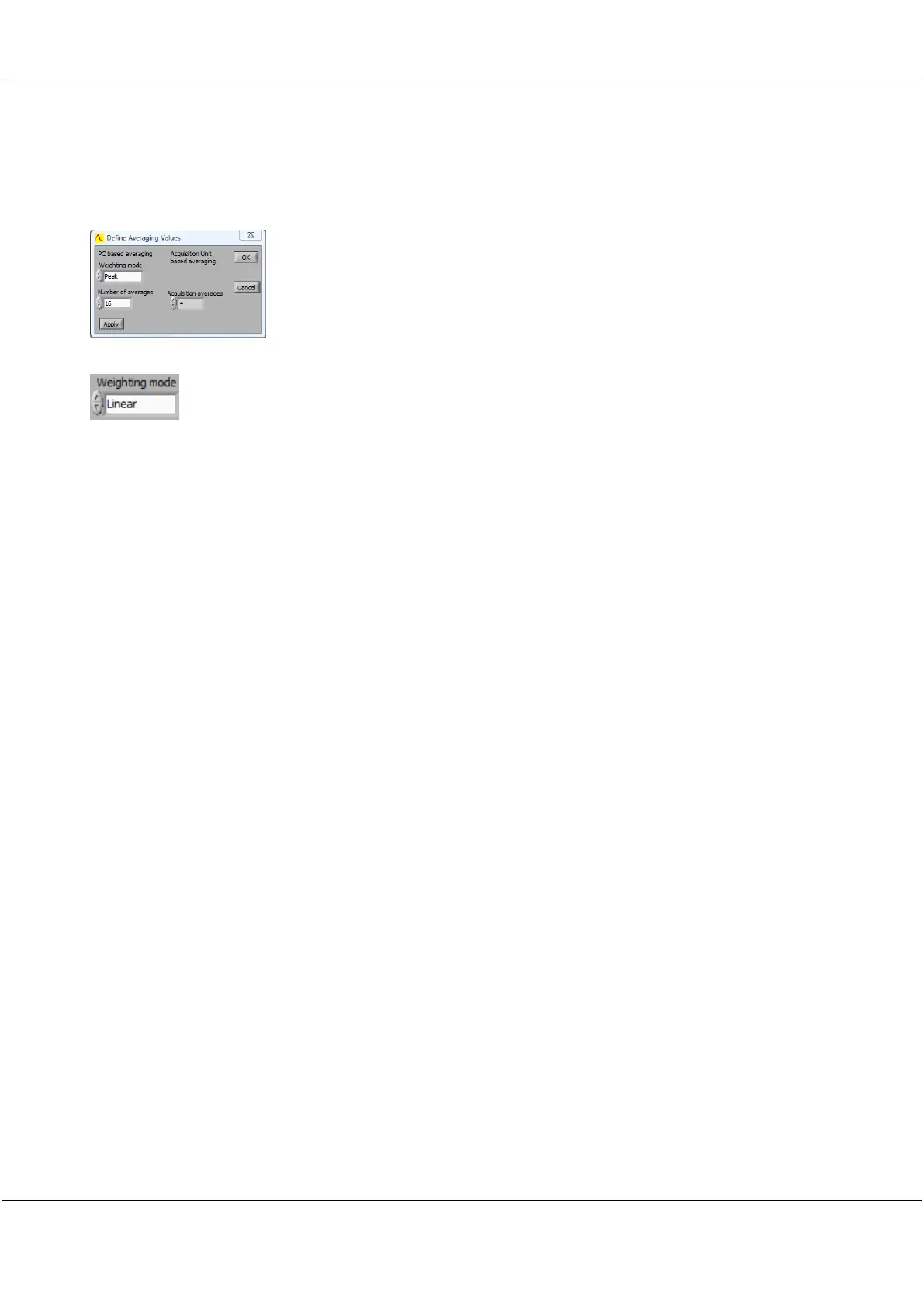
Click the arrows or in the field to select from the dropdown list.
Options are: Linear, Exponential, or Peak.
Linear averages with equal weighting. It sums a number of captured frames and
then calculates a new frame which is the average of them all. The number of frames
being averaged may be set in Number of averages.
Triggering can be used to ensure that all of the averaged frames are aligned with
respect to the cycle of the captured signal.
Example: If 16 frames are being averaged then a new frame is displayed only after
16 frames have been captured, transferred and averaged.
The PC calculates the average for a new frame every time a frame is captured and
transferred from the acquisition hardware. Automatic frame capture, triggering, and
frame transfer will continue to work as it does without averaging. Triggering can be
used to ensure that all of the averaged frames are aligned with respect to the cycle
of the captured signal.
Older frames contribute less than more recent frames to each calculated average.
The contribution of a frame to each new calculated average diminishes exponentially
with time as new frames are transferred and new averages calculated. The
contribution of older frames to the most recently calculated average is never lost
however (unless averaging is turned off or reset).
Note: Peak averaging can only be applied to the Spectrum Display.
Peak averaging is useful where you want to accumulate in one spectrum the
maximum frequency points from the spectra of a number of frames. Peak averaging
can only be used to accumulate the peak frequency levels from consecutive spectra
and is not relevant for use in the time domain.
When Peak averaging is used the spectrum of a frame of signal data is calculated
and the frequency points are saved in an averaging array. When the frequency
points of a newly captured frame are loaded into the averaging array only those
points whose levels are both greater than their counterparts in the current array are
actually loaded. In this way all the frequency points in the peak averaging array
represent the greatest levels so far recorded at those points.
Peak averaging is also useful if you are doing Gain/Phase plots. Instead of using a
white noise generator to produce an input signal that contains all the frequency
points of interest in one frame, a sweep frequency signal generator can be used to
build up the gain and phase response of the system over a number of frames.



 To Next Page