M A E D A Mini-Crawler Crane Section 4 – CRANE OPERATION
1/2019 MC285C-3 4-55
• Always use a supervisor on the ground to
assist with directions.
• Always observe the following:
• Use cranes of the same model.
• Choose the machine model that can
handle sufficiently larger load than the
load to be hoisted.
• Make sure only one person gives
direction.
• Limit the crane operations to a single
operation and do not attempt any
slewing operations.
• Appoint only one experienced slinger
to assist.
WARNING! The following safety messages
address a potential Sudden Movement Hazard
while operating the crane or boom:
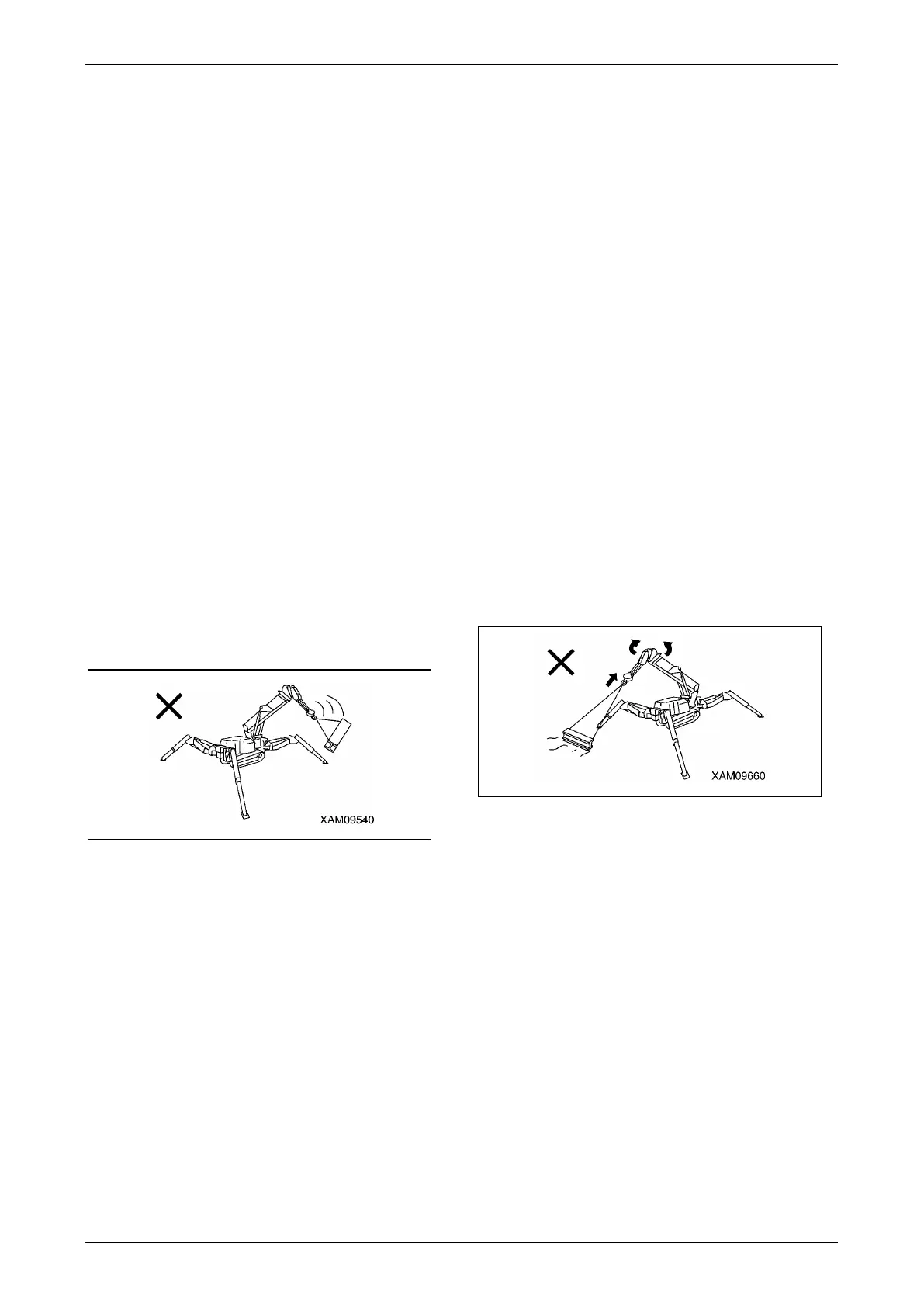
• Do not move the slewing, boom lowering or
hook lowering levers suddenly. Always
move the slewing, boom lowering and hook
lowering levers slowly.
• Do not move the slewing, boom lowering
and hook lowering levers with the engine set
at any speed other than low. Always move
the slewing, boom lowering and hook
lowering levers with the engine at low speed.
Fig. 4-151
• Do not leave the driving operation position
when a load is hoisted. Lower the load
before leaving the machine.
• Keep the hook block wound up when not in
use. Otherwise, the person near the load
may collide with the hook block.
WARNING! The following safety messages
address a potential Visual Impairment Hazard
while operating the crane or boom:
• Do not work if visually impaired due to
worksite location or weather.
• Always use adequate lighting when working
in dark areas.
WARNING! The following safety messages
address a potential Tip Hazard while operating
the crane or boom:
• Always rotate a hoisted load slowly, in the
360-degree slewing position, using a short
working radius and with the engine at low
speed regardless of the load size. The
machine could become unsteady if a short
working radius is not used and the engine is
operating at a high speed.
• Be sure to operate the crane and boom
levers slowly when a load is hoisted. Sudden
lever movement may cause the load to move
suddenly, resulting in loss of control of the
machine.
• Do not use the slewing position other than
when slewing the load. Using the slewing
position to bring forth a load or reposition a
load to stand up is prohibited.
Fig. 4-152
• Never allow a hoisted load to contact an
outrigger while slewing the load. Certain
outrigger placement may be unavoidable
when setting the machine. Use caution while
slewing the load to avoid contact with an
outrigger.
WARNING! Entanglement Hazard. Do not
allow a hoisted load to contact any obstacles
while hoisting a load or slewing a load. Be
aware of the surroundings. Do not allow the
load to contact obstacles such as trees,
construction material or other objects. If
caught by an obstacle, do not forcibly wind
the hoisted load. Untangle the caught item
before winding the load.


 To Next Page