239
Polyend Tracker+ Manual
NOTES
Audio
8
Tweaking and trying different settings is encouraged on creative audio
effects. While this is also possible on the process orientated tools, it is also
recommended to get to know these parameters functions and purposes and
have a basic understanding of their operation.
Equalizer
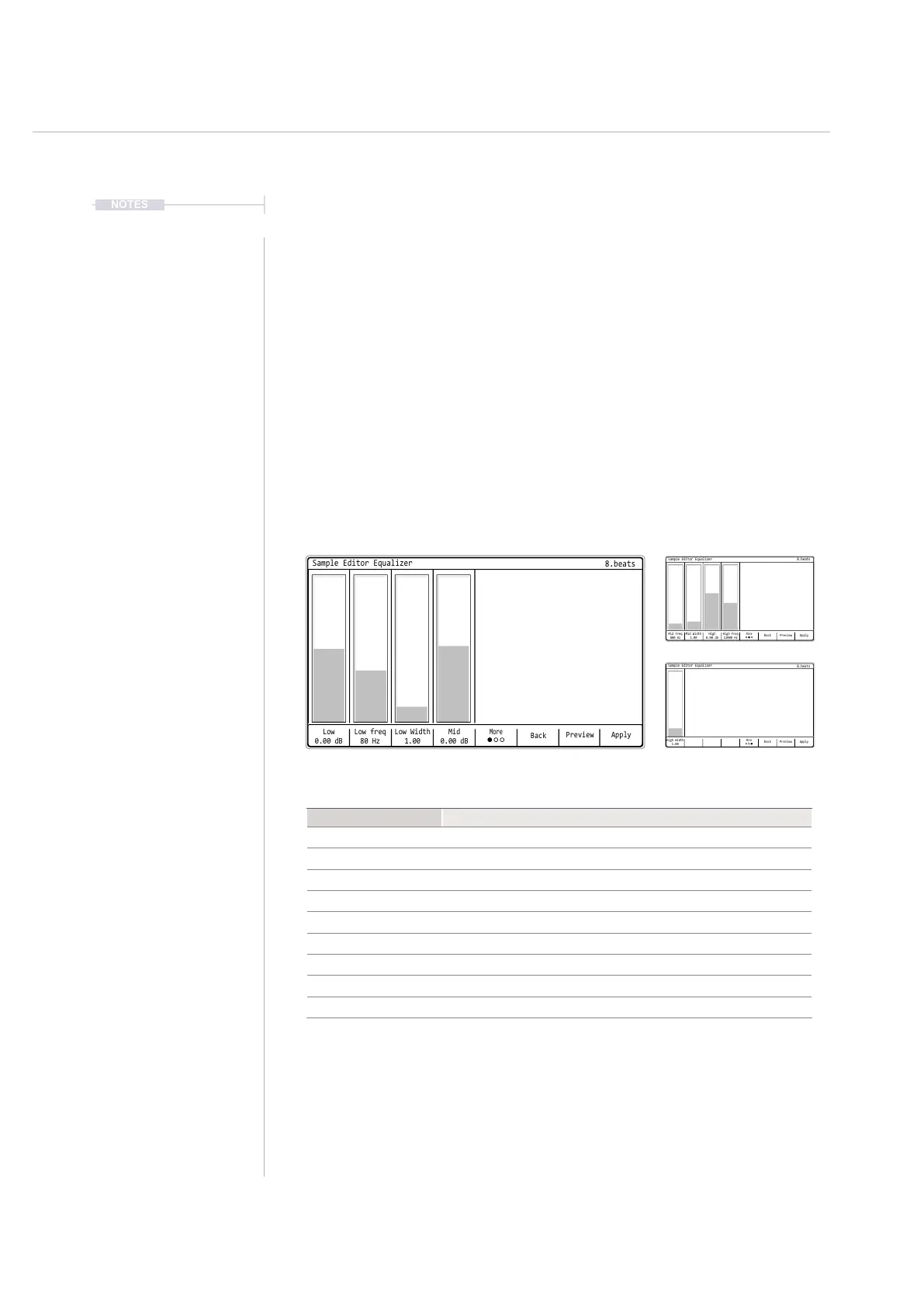
The purpose of an equalizer, also called EQ, is to boost or attenuate
frequencies in an audio signal to either adjust the tonal characteristics or to
x unwanted frequency elements. Equalizers are typically used to shape a
sounds character but also to allow a sound to sit comfortably alongside
another. The sample editor EQ effect has 3 frequency bands. More
coverage of general EQ functions is provided in the Master Effects section.
Back
Low
0.00 dB
Low Width
1.00
Mid
0.00 dB
More
Low freq
80 Hz
ApplyPreview
Sample Editor Equalizer
8.beats
Back
Mid freq
800 Hz
High
0.00 db
High freq
12000 Hz
More
Mid Width
1.00
ApplyPreview
Sample Editor Equalizer
8.beats
Back
High Width
1.00
More
ApplyPreview
Sample Editor Equalizer
8.beats
Page 1 of 3 Page 2 of 3
Page 3 of 3
EQ Function
Description
Low Low attenuation or boost amount, -12 dB to + 12dB.
Low Freq Low Frequency range, 10Hz - 200Hz
Low Width Width of EQ, also called Q. Range 0.5 to 5.
Mid Mid attenuation or boost amount, -12 dB to + 12dB.
Mid Freq Low Frequency range, 100Hz - 8KHz
Mid Width Width of EQ, also called Q. Range 0.5 to 5.
High High attenuation or boost amount, -12 dB to + 12dB.
High Freq High Frequency range, 8KHz -20KHz
High Width Width of EQ, also called Q. Range 0.5 to 5.


 To Next Page