Because RFL™ and Hubbell® have a policy of continuous product improvement, we reserve the right to change designs and specifications without notice.
M-DACS-T1 RFL Electronics Inc.
October 16, 2012 2-3 (973) 334-3100
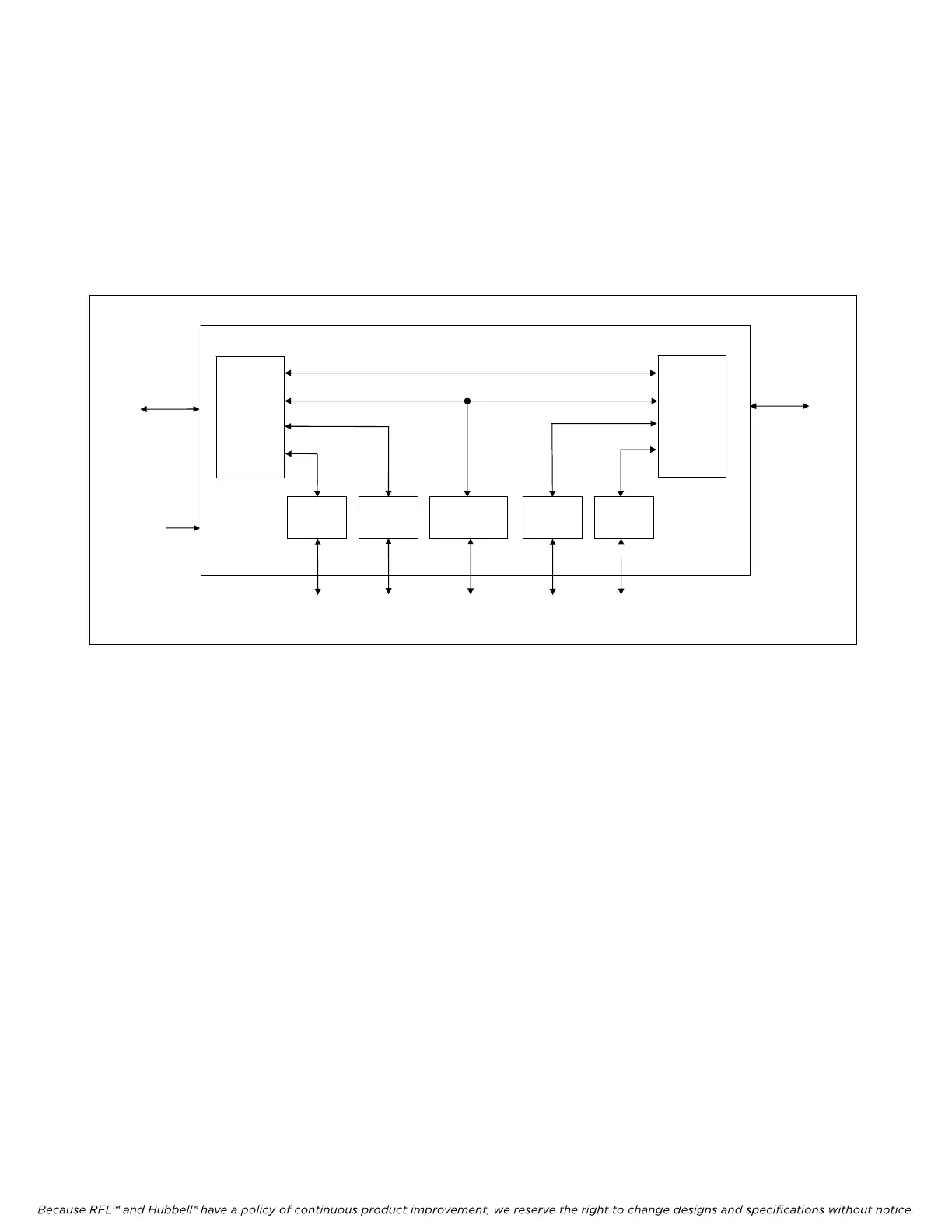
2.2.3 DROP/INSERT FUNCTIONALITY
A drop/insert multiplexer is essentially a multiplexer configured as two back-to-back T1 Common
Modules (CM4s), in which some circuits terminate while others pass through. A drop/insert
multiplexer can terminate payload circuits from either of two different T1 circuits; that is, from either
of two different locations. (See Figure 2-2)
CHANNEL
MODULES
T1 CIRCUIT
FROM/TO
DACS MODULE
VOICE
MODULE
VOICE
MODULE
DATA
MODULE
DATA
MODULE
ORDERWIRE
MODULE
P A Y L O A D C I R C U I T S
CM4
CM4
T1 CIRCUIT
FROM/TO
DACS MODULE
Figure 2-2. Functional diagram of Drop/Insert section of M-DACS
2.2.4 POINT-TO-POINT SYSTEMS
The simplest type of IMUX 2000 M-DACS system configuration is a point-to-point system. A point-
to-point system consists of two M-DACS multiplexers connected by a single T1 electrical or fiber
optic circuit. (See Figure 2-3.) As the figure illustrates, the same payload circuits will appear at both
ends of a point-to-point system. Most payload types (such as voice and full-duplex data circuits) are bi-
directional, and will have both an input and an output at each multiplexer.
2.2.5 LINEAR DROP/INSERT SYSTEMS
The addition of one or more drop/insert multiplexers converts a simple point-to-point system into a
linear drop/insert system. (See Figure 2-4.) Data, voice, and orderwire (multiple drop voice) circuits
can be established between any two locations in a T1 linear drop/insert system. As shown in Figure 2-4,
a three-location system can provide circuits between Locations 1 and 2, Locations 2 and 3, and
Locations 1 and 3. The only limiting factor is the capacity of the T1 circuit between any two adjacent
locations, which is 24 time slots. Linear Drop/insert systems are not limited to a single drop/insert
multiplexer, and may contain more than three locations.



 To Next Page