Because RFL™ and Hubbell® have a policy of continuous product improvement, we reserve the right to change designs and specifications without notice.
2.3.3.4 Multiplexing Of Channels To Form T1 Aggregate
The multiplexer develops backplane bus synchronization signals. The transmit section of each channel
module synchronizes to these signals, and places its data onto the selected bus. The multiplexer then
forms the aggregate signal, using the selected framing format (SF or ESF).
2.3.3.5 Multiplexer/Demultiplexer Bus Interface To Channels
The CM4 uses tri-state bus drivers and receivers to permit routing the demultiplexer and multiplexer
bus signals to either of two backplane buses (Bus A or Bus B). This versatile bus capability enables
simple configuration of a multiplexer as a "drop/insert."
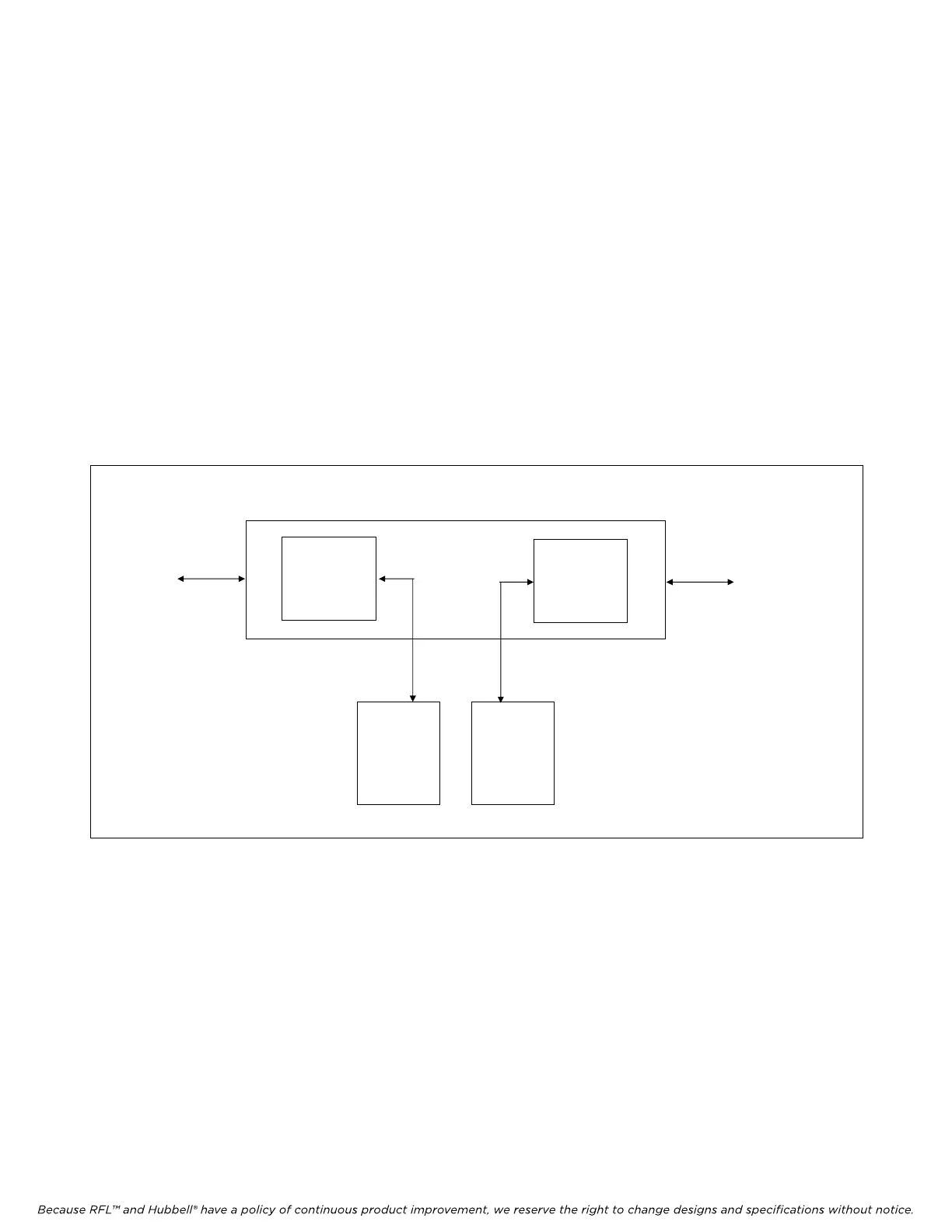
Bus A/B nomenclature is used to set channel modules to transmit and receive through a desired drop-
and-insert port. In order to transmit out of drop-and-insert A, a channel module is set to operate on Bus
A. In order to transmit out of drop-and-insert B, a channel module is set to operate on Bus B. This can
be seen in Figure 2-16.
DI/A
DI/B
CHANNEL
MODULE
SET TO
BUS B
CHANNEL
MODULE
SET TO
BUS A
Figure 2-16. The meaning of Bus A and Bus B channel module settings
2.3.3.6 Transmit Timing Functions
The CM4 enables the selection of LOOP, INTERNAL, EXTERNAL, or THRU timing. In addition to
primary timing, the CM4 provides a fallback timing setting. Fallback timing takes effect automatically
when conditions cause a loss of primary timing; for example, in case of frame loss when LOOP is the
primary timing setting. Refer to paragraph 5.5.3.7.1.1 for suggested settings of fallback timing.
M-DACS-T1 RFL Electronics Inc.
October 16, 2012 2-30 (973) 334-3100



 To Next Page