U.6.28
SEL-421 Relay User’s Guide Date Code 20090715
Testing and Troubleshooting
Checking Relay Operation
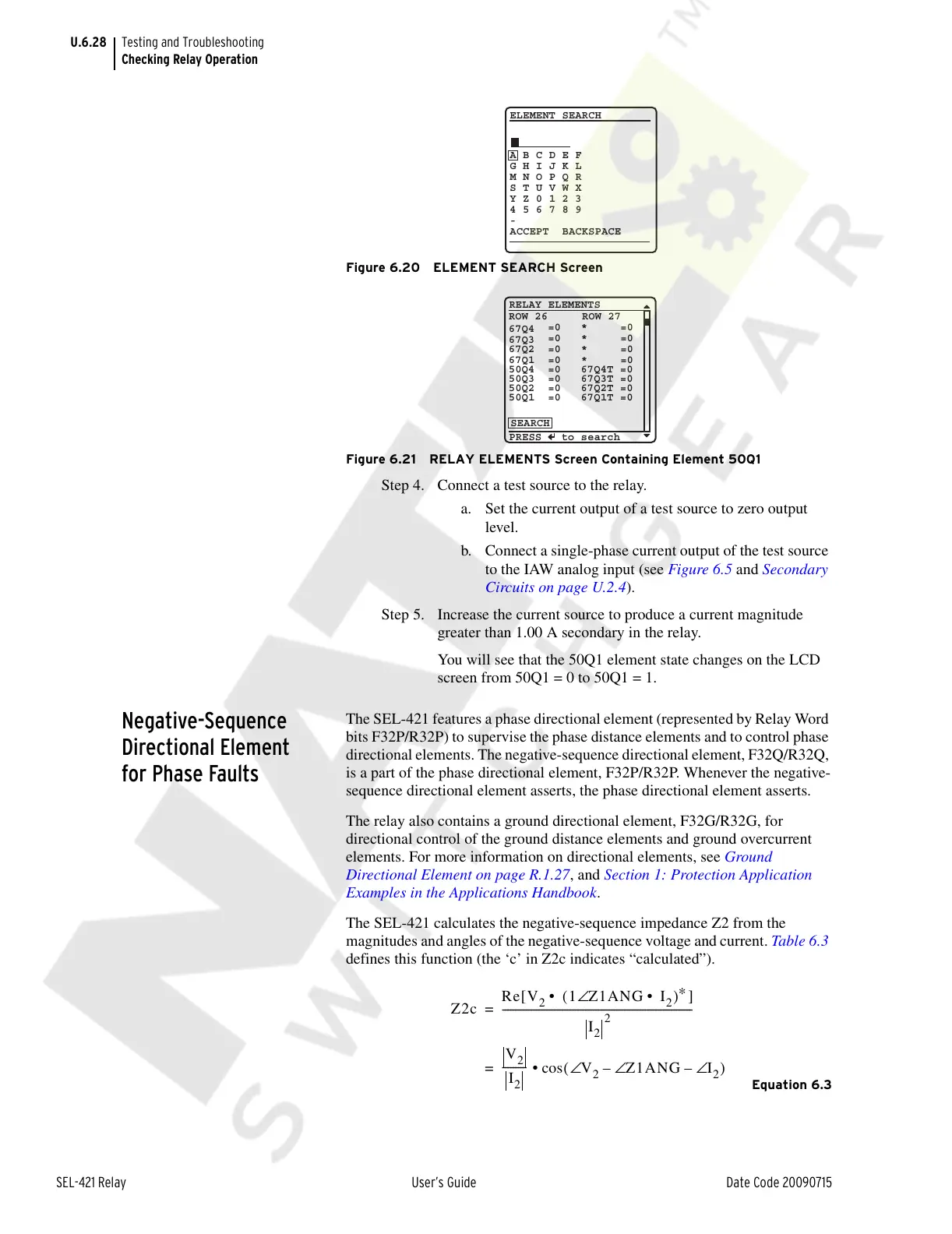
Figure 6.20 ELEMENT SEARCH Screen
Figure 6.21 RELAY ELEMENTS Screen Containing Element 50Q1
Step 4. Connect a test source to the relay.
a. Set the current output of a test source to zero output
level.
b. Connect a single-phase current output of the test source
to the IAW analog input (see Figure 6.5 and Secondary
Circuits on page U.2.4).
Step 5. Increase the current source to produce a current magnitude
greater than 1.00 A secondary in the relay.
You will see that the 50Q1 element state changes on the LCD
screen from 50Q1 = 0 to 50Q1 = 1.
Negative-Sequence
Directional Element
for Phase Faults
The SEL-421 features a phase directional element (represented by Relay Word
bits F32P/R32P) to supervise the phase distance elements and to control phase
directional elements. The negative-sequence directional element, F32Q/R32Q,
is a part of the phase directional element, F32P/R32P. Whenever the negative-
sequence directional element asserts, the phase directional element asserts.
The relay also contains a ground directional element, F32G/R32G, for
directional control of the ground distance elements and ground overcurrent
elements. For more information on directional elements, see Ground
Directional Element on page R.1.27, and Section 1: Protection Application
Examples in the Applications Handbook.
The SEL-421 calculates the negative-sequence impedance Z2 from the
magnitudes and angles of the negative-sequence voltage and current. Tabl e 6 . 3
defines this function (the ‘c’ in Z2c indicates “calculated”).
Equation 6.3
ELEMENT SEARCH
A B C D E F
G H I J K L
M N O P Q R
S T U V W X
Y Z 0 1 2 3
4 5 6 7 8 9
-
ACCEPT BACKSPACE
PRESS to search
RELAY ELEMENTS
SEARCH
ROW 26 ROW 27
67Q4
=0 * =0
67Q3
=0 * =0
67Q2 =0 * =0
67Q1 =0 * =0
50Q4 =0 67Q4T =0
50Q3 =0 67Q3T =0
50Q2 =0 67Q2T =0
50Q1 =0 67Q1T =0
Z2c
Re V
2
1Z1ANG I
2
• ∠()
∗
• []
I
2
2
-------------------------------------------------------------------------=
V
2
I
2
---------
• cos V
2
Z1ANG I
2
∠–∠–∠()=
Courtesy of NationalSwitchgear.com


 To Next Page