U.4.45
Date Code 20090715 User’s Guide SEL-421 Relay
Basic Relay Operations
Reading Oscillograms, Event Reports, and SER
Step 1. Configure the communications port.
a. Start
ACSELERATOR QuickSet.
b. On the top toolbar, open the Communication menu,
and then click Port Parameters.
You will see the Port Parameters dialog box similar to
Figure 4.7.
c. Select the Data Speed, Data Bits, Stop Bits, Parity,
and RTS/CTS that match the relay settings. The
defaults are 9600, 8, 1, None, Off, respectively.
d. Click OK to update the
ACSELERATOR QuickSet
communications parameters.
e. Confirm that the Communications Status bar at the
bottom of the
ACSELERATOR QuickSet window says
Connected.
Step 2. Confirm that you have loaded the correct passwords in
ACSELERATOR QuickSet.
a. Enter your Access Level 1 password in the Level One
Password text box, and your Access Level 2 password
in the Level Two Password text box.
b. Click OK to accept changes and close the dialog box.
Step 3. To view the event history report, open the
ACSELERATOR
QuickSet Analysis menu and click View Event History.
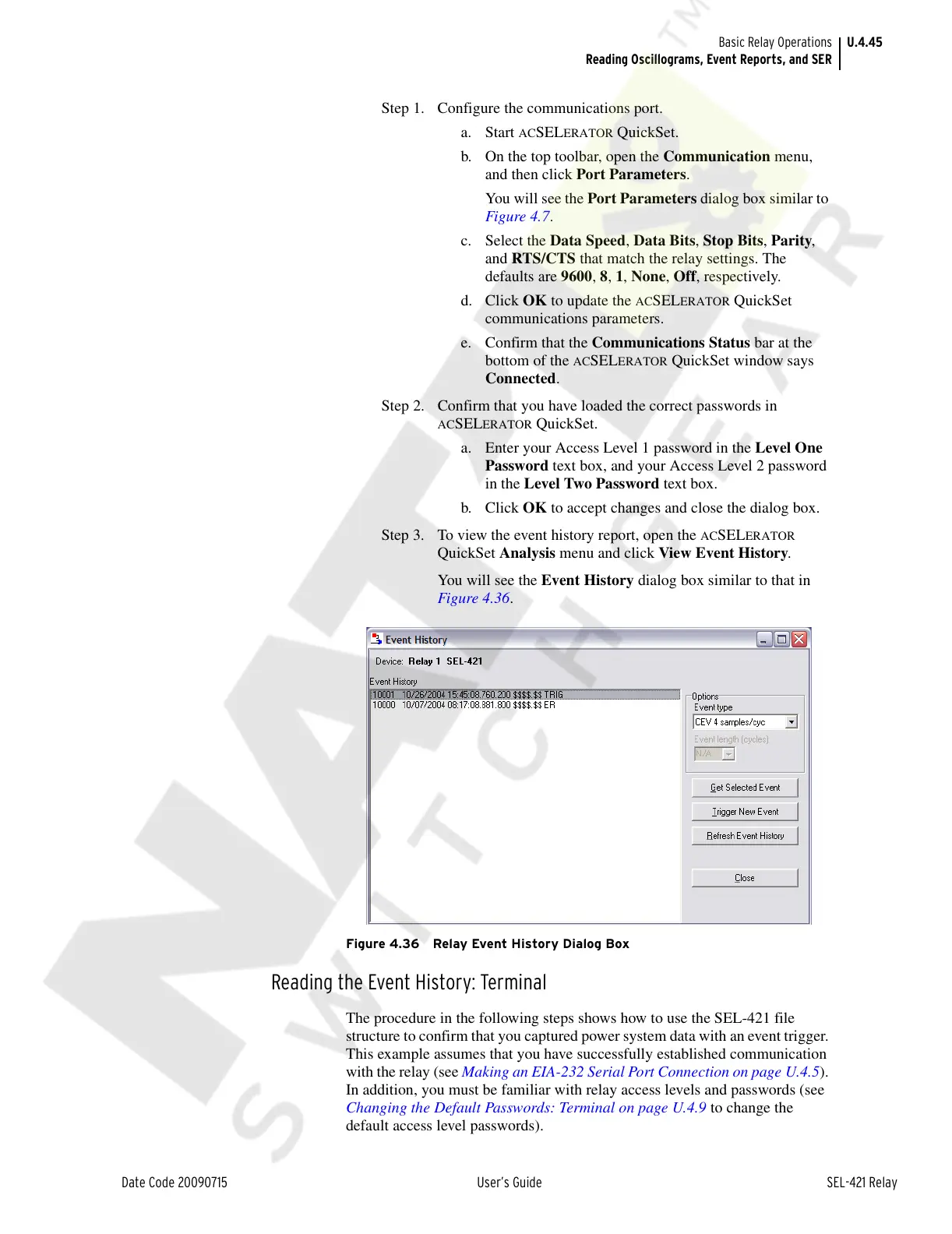
You will see the Event History dialog box similar to that in
Figure 4.36.
Figure 4.36 Relay Event History Dialog Box
Reading the Event History: Terminal
The procedure in the following steps shows how to use the SEL-421 file
structure to confirm that you captured power system data with an event trigger.
This example assumes that you have successfully established communication
with the relay (see Making an EIA-232 Serial Port Connection on page U.4.5).
In addition, you must be familiar with relay access levels and passwords (see
Changing the Default Passwords: Terminal on page U.4.9 to change the
default access level passwords).
Courtesy of NationalSwitchgear.com


 To Next Page