#1,Xccc,X?,Xccc,(...),X?,Xccc;
where:
X - the group code, ccc - the code value,
X? - the request to send the current X code setting.
The instrument will output a control settings file for all requests X? in the following format:
#1,Xccc,Xccc,(...),Xccc;
In order to read out all current control settings the user should send to the device the following
characters:
#1;
The instrument will output a control settings file in the format:
#1,Xccc,Xccc,(...),Xccc;
Example: The following sequence of characters:
#1,U958,N4000,Z0:1,Z0:2,Z0:3,Z1:4,M3,Y1000,Xa1,Xv1,Xd1,XA0,XR0,S0;
means that:
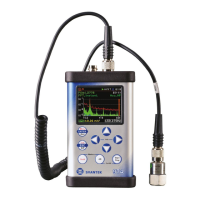
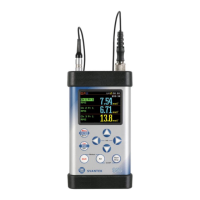
• the SVAN 958 is investigated (U958),
• the unit’s number is 4000 (N4000),
• the Vibration Level Mode is selected in channel 1 (Z0:1),
• the Vibration Level Mode is selected in channel 2 (Z0:2),
• the Vibration Level Mode is selected in channel 3 (Z0:3),
• the Sound Level Mode is selected in channel 4 (Z1:4),
• the 1/3 OCTAVE analyser function is selected (M3),
• the measurement start delay is equal to 1000 milliseconds (Y1000),
• the reference level for acceleration measurement is set to 1 µms
-2
(Xa1),
• the reference level for velocity measurement is set to 1 nms
-1
(Xv1),
• the reference level for displacement measurement is set to 1 pm (Xd1),
• the AutoSave option is switched off (XA0),
• the RAM file will not be created (XR0),
• the instrument is in the STOP state (S0).
Note: All bytes of that transmission are ASCII characters.
Note: Any setting can be changed only when the instrument is in the STOP state (S0).


 To Next Page