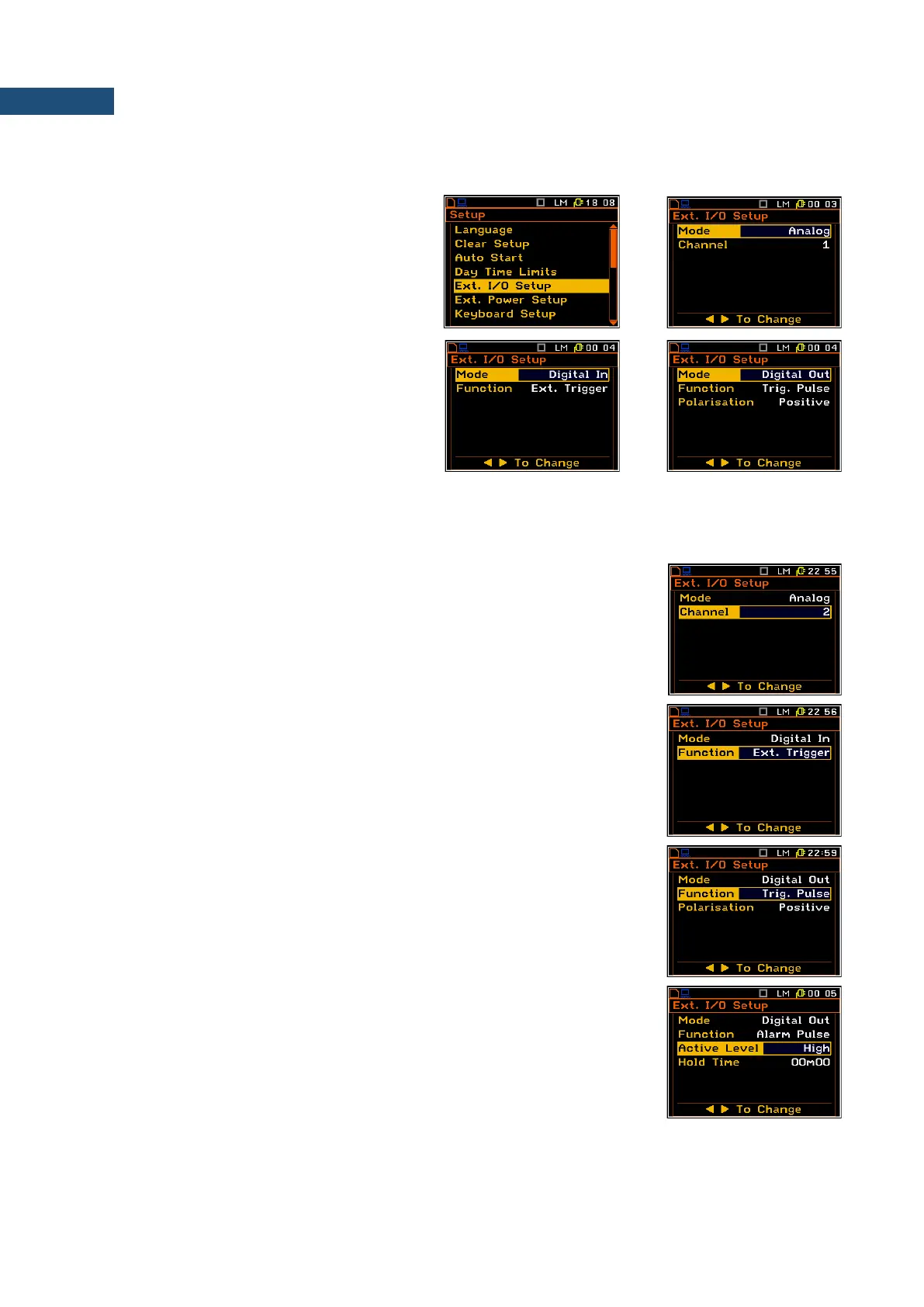
7.5 SELECTION OF THE EXTENDED MODE – EXT. I/O SETUP
The Ext. I/O Setup enables the user to select
the function of the instrument’s socket named
as I/O. This socket can be used as:
• the output of the analogue signal (Analog)
transmitted from the input of the instrument
to its output without any digital processing
(i.e. frequency filtering);
• the input of the digital signal used as an
external trigger to start the measurements
(Digital In) in the instrument, acting in this
case as a so called “slave instrument”;
• the digital output (Digital Out) used for
triggering another “slave instrument” (the
instrument is acting in this case as a
“master instrument”), or as a source of any
alarm signal in the case of certain
circumstances occurred during the
measurements (i.e. the level of the input
signal was higher than selected one).
In the Analog mode, the meter can send signals to the output device. For
example, the signal can be observed on the oscilloscope from the selected
Channel. The user has the opportunity to choose between Channel 1, 2, 3
and 4.
In the Digital In mode, the signal that appeared on the I/O socket will be
treated as the external trigger which starts the measurement. In this mode
the Ext. I/O function is set to Ext. Trigger.
In the Digital Out mode, the instrument generates a signal on the I/O socket
will be treated as an external device trigger pulse or as an alarm pulse.
The Function item allows selecting the function in the Digital Out mode of
the I/O socket. The socket can be used as a source of the trigger pulse
(Trig. Pulse) which triggers so called “slave” device or as an alarm signal
(Alarm Pulse), which appears there after fulfilment of certain conditions.
In case of Trig. Pulse, the Polarisation item appears, in which you can
select which polarisation of the signal (negative or positive) will be applied.
In case of Alarm Pulse the Active Level position appears, which enables
the user to select which level of the signal should be treated as a valid one
(“negative” or “positive” logic): Low or High.
The Hold Time position defines the minimum duration of alarm signal.


 To Next Page