7.8 LOCKING THE MENU – MENU LOCK
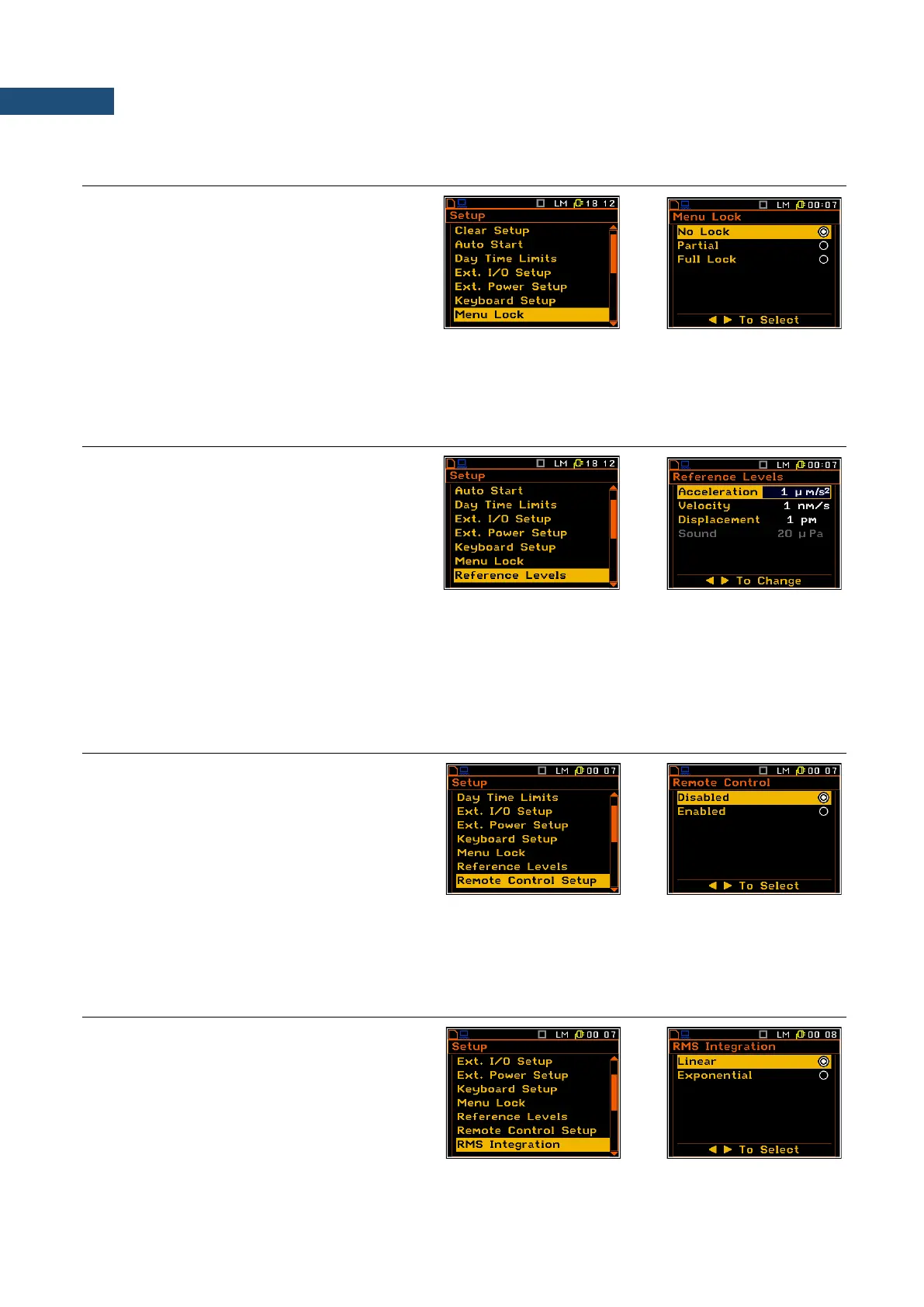
The Menu Lock sub-list enables the user to
lock (Partial or Full Lock) and unlock the
menu.
In the case of default No Lock option all
available positions in the menu are accessible
due to the settings, which were made.
The activation of Partial results in locking access to the Menu options, which are responsible for measurement
parameters. In the case of Full Lock no one position from the Menu lists is accessible and after attempt of
enter Menu the Menu Lock list appears on the display. The Menu is available after unlocking it.
7.9 REFERENCE SIGNAL IN VIBRATION MEASUREMENTS – REFERENCE LEVELS
The Reference Levels sub-list enables the
user to set the reference level of the vibration
signal. The values, which are set here, are
taken into account during the calculations of
the measurement results expressed in the
Logarithmic scale (with the dB as the units).
In the Acceleration position the user can set the reference level of the acceleration signal from 1 µms
-2
to
100 µms
-2
. In the Velocity position the user can set the reference level of the velocity signal. It is possible to
set this level from 1 nms
-1
to 100 nms
-1
. In the Displacement position the user can set the reference level of
the displacement signal. It is possible to set this level from 1 pm to 100 pm.
The reference level for sound measurements cannot be changed.
7.10 ACTIVATING THE REMOTE CONTROL ERROR CONFIRMATION – REMOTE CONTROL SETUP
The Remote Control Setup position enables
the user to activate or deactivate error
confirmation function. If
Remote Control Setup function is Enabled
then the instrument confirms warnings after 5
seconds and the user reaction is not required.
This function is very useful when the
instrument is working as remote controlled. If
Remote Control Setup function is Disabled
then the instrument waits for the user reaction.
This mode is used in normal mode.
7.11 SELECTION OF DETECTOR’S TYPE IN THE LEQ (RMS) CALCULATIONS – RMS INTEGRATION
The RMS Integration enables the user to
select the detector type for the calculations of
the LEQ function (in the case of sound
measurements) or the RMS function (in the
case of vibration measurements).
Two options are available: Linear and
Exponential.


 To Next Page