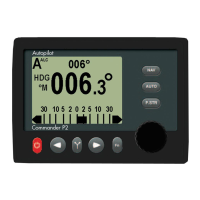
ComNav Commander P2 & P2VS Installation & Operation Basic Operations
Document PN 29010074 V4.1 - 111 -
3)
P
P
O
O
R
R
T
T
button.
Pressing and holding this button while in
POWER STEER
mode moves the rudder to
Port – and it keeps moving for as long as the button is held.
Pressing and holding this button while in
AUTO
,
NAV
,
WORK
or
WIND
modes allows
you to avoid obstacles in the boat’s path, by turning to Port.
This button is also used in menu operations – to move the highlight to the previous line.
4)
T
T
U
U
R
R
N
N
button.
Pressing this button once while in
AUTO
or
WORK
modes queues the default
pre-programmed turn; in
WIND
mode, it queues a Tack or Gybe turn. Subsequent
presses of the
T
T
U
U
R
R
N
N
button scroll through all of the available turn-types.
The pre-programmed turn sequence is then initiated by pressing either the
P
P
O
O
R
R
T
T
or
S
S
T
T
A
A
R
R
B
B
O
O
A
A
R
R
D
D
button to indicate the direction of the turn.
See
Default Turn
on page 117 for more details on setting the default turn from the
Special Turns available.
5)
S
S
T
T
A
A
R
R
B
B
O
O
A
A
R
R
D
D
button.
Pressing and holding this button while in
POWER STEER
mode moves the rudder to
Starboard – and it keeps moving for as long as the button is held.
Pressing and holding this button while in
AUTO
,
NAV
,
WORK
or
WIND
modes allows
you to avoid obstacles in the boat’s path, by turning to Starboard.
This button is also used in menu operations – to move the highlight to the next line.
6)
F
F
n
n
button. This is a multi-function button:
•
On all boats except sailboats, this
button invokes
WORK
mode while in
AUTO
or
NAV
modes; double-pressing the button will bring up (or exit) the Work
mode menu.
•
On a sailboat, this button invokes
WIND
mode while in
AUTO
mode; double-pressing
the button will bring up (or exit) the Wind mode menu.
•
Pressing this button when an alarm occurs will cancel the alarm.
•
This button is also used during Dockside Setup, and in operating modes & menus.
7)
C
C
O
O
U
U
R
R
S
S
E
E
C
C
H
H
A
A
N
N
G
G
E
E
knob. This is used in several ways:
•
In
POWER STEER
mode, it changes the rudder angle in the same direction as the
knob is turned.
•
In
AUTO
mode, it changes the Commanded Heading in the same direction as the
knob is turned.
Note: Heading can not be changed during any HEADING Alarm.
•
The knob is also used to change parameters in the various menus.
8)
P
P
O
O
W
W
E
E
R
R
S
S
T
T
E
E
E
E
R
R
(
P
P
.
.
S
S
T
T
R
R
) button.
Pressing & holding this button places the autopilot into
POWER STEER
mode.
A double-press of this button brings up (or exits) the Power Steer mode menu.
9)
A
A
U
U
T
T
O
O
button.
Pressing & holding this button places the autopilot into
AUTO
mode.
A double-press of this button brings up (or exits) the Auto
mode menu.
10)
N
N
A
A
V
V
button.
Pressing & holding this button places the autopilot into
NAV
mode.
A double-press of this button brings up (or exits) the Nav
mode menu.


 To Next Page