ComNav Commander P2 & P2VS Installation & Operation Basic Operations
Document PN 29010074 V4.1 - 135 -
There is one major drawback to XTE Correction, however.
The course steered when Correction is set to “XTE” is usually not the most efficient in terms
of overall distance traveled.
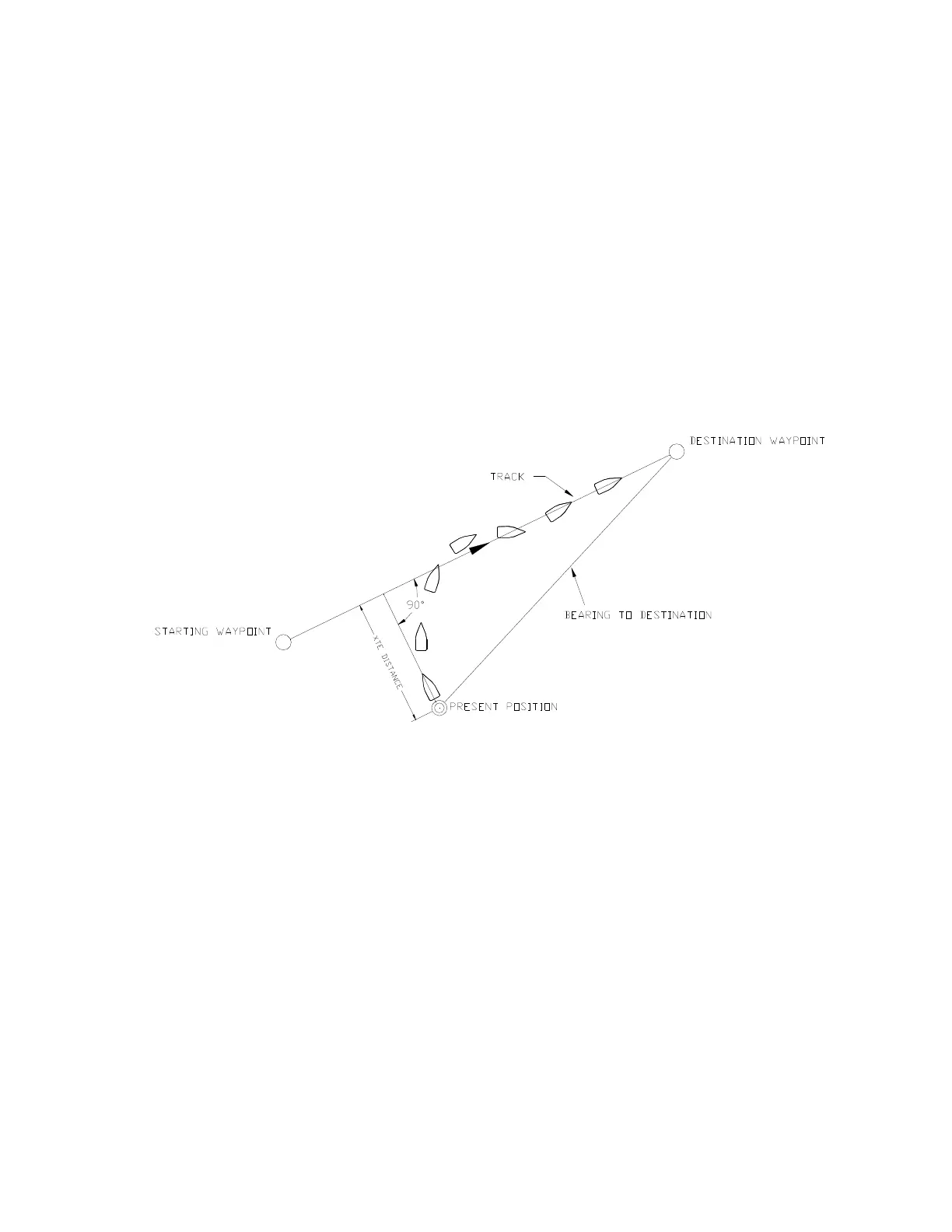
The main problem is that the sum of the distance travelled at a right angle to the Track (i.e.,
along the XTE distance), and then along the Track – in other words, along the two “right
angle” sides of the triangle, in the figure below – is obviously greater than the path direct to
the destination.
Also, if there is a large Cross-Track Error, the autopilot may overshoot the desired Track, and
then gradually settle on to it. This is a function of turn rate, boat speed, and position updates
received from the Navigation System.
•
All of these effects are lessened when “Correction” is set to “Both” (see next page).
For best performance, it is always best to minimize any Cross-Track Error
before
putting the autopilot into NAV mode!
Figure 88 – Response of Boat to a Large Cross-Track Error
Large Cross-Track Error Effects
There is another potential drawback to XTE Correction.
If the Cross-Track Error is large, the autopilot will steer a Heading which can be almost
perpendicular to the desired Track.
This may be annoying – and it might even be unsafe, depending on what objects or other
boats are near you at the time.
However, the total number of degrees that the autopilot will adjust the Commanded Heading
away from the desired Track is limited to the value set for “Max Correction”.
By using this parameter – by setting it to something less than the factory-default of 90° – you
can thus limit the possibly-undesired effects of the “perpendicular to Track” behaviour of the
autopilot.


 To Next Page