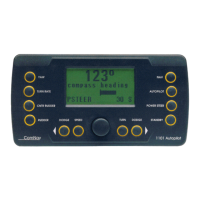
ComNav Commander P2 & P2VS Installation & Operation Care & Maintenance
Document PN 29010074 V4.1 - 177 -
Care & Maintenance
The Commander P2 and Commander P2VS Autopilot Systems have been designed to
provide many years of reliable service.
Periodic care and maintenance will help to ensure the longevity of your autopilot.
Cleaning and Appearance
Both the Control Head and SPU should be carefully cleaned with a damp cloth and mild
soap. This is particularly important for the LCD screen overlay.
Do not use abrasive cleaners or chemicals.
The Control Head is designed to be weatherproof and splash resistant, but it should not be
immersed in water for a prolonged period of time.
Environments exceeding a maximum temperature of 140° F (60° C) or below a minimum
temperature of 5° F (-15° C) MUST BE AVOIDED.
Exposure to prolonged direct sunlight should be avoided in order to prevent damage to the
electronics and housing, and UV-induced fading of the LCD.
Periodic Checks
After the first six months of operation a thorough examination of the entire Autopilot system
MUST BE UNDERTAKEN.
Electrical & Mechanical Checks
All electrical connections, cables, clamps, mounting brackets, and mechanical connections
(e.g., the Rudder Follower Unit’s connection to the rudder post) must still be secure.
An ANNUAL inspection should be undertaken thereafter.
Hydraulic Checks
It is unfortunate – but true – that
no hydraulic system is always trouble-free!
Hydraulic oil
under even mild pressure can find its way through any weak spot – often holes too small to
see with the naked eye.
And so, regular inspection & maintenance is
always
needed.
In particular, all hydraulic pumps, hoses, fittings & joints must be regularly inspected for
leakage, cracks or loose mounting, and for correct tightness of all the fittings & joints.
A very good, yet easy, test for leaks is to check the oil level at the reservoir (or the highest
helm pump in your steering system). If the level constantly goes down, there are quite
probably some leaks in the system; the most likely culprits are the hoses, joints & fittings.
Manual Steering Operation
The most basic check is to see if your manual steering system is working. Be sure to test it
at each steering station on the boat, one at a time.
1) Check that when turning the helm to Starboard, the rudder actually moves so as to turn
the boat to Starboard.
2) Check that when the helm is turned to Port, the rudder moves to turn the boat to Port.
Air Trapped in the Hydraulic System
Following the initial installation and bleeding of a hydraulic pump – or after repairing a leaking
hose/fitting/etc. – some residual air may remain suspended in the hydraulic oil.
During the first few weeks after installation or repair, this air will gradually bleed out through
the header tank or the highest helm pump, and as a result the hydraulic fluid level may go
down. Check the fluid level several times during this period, and add more oil as required.


 To Next Page