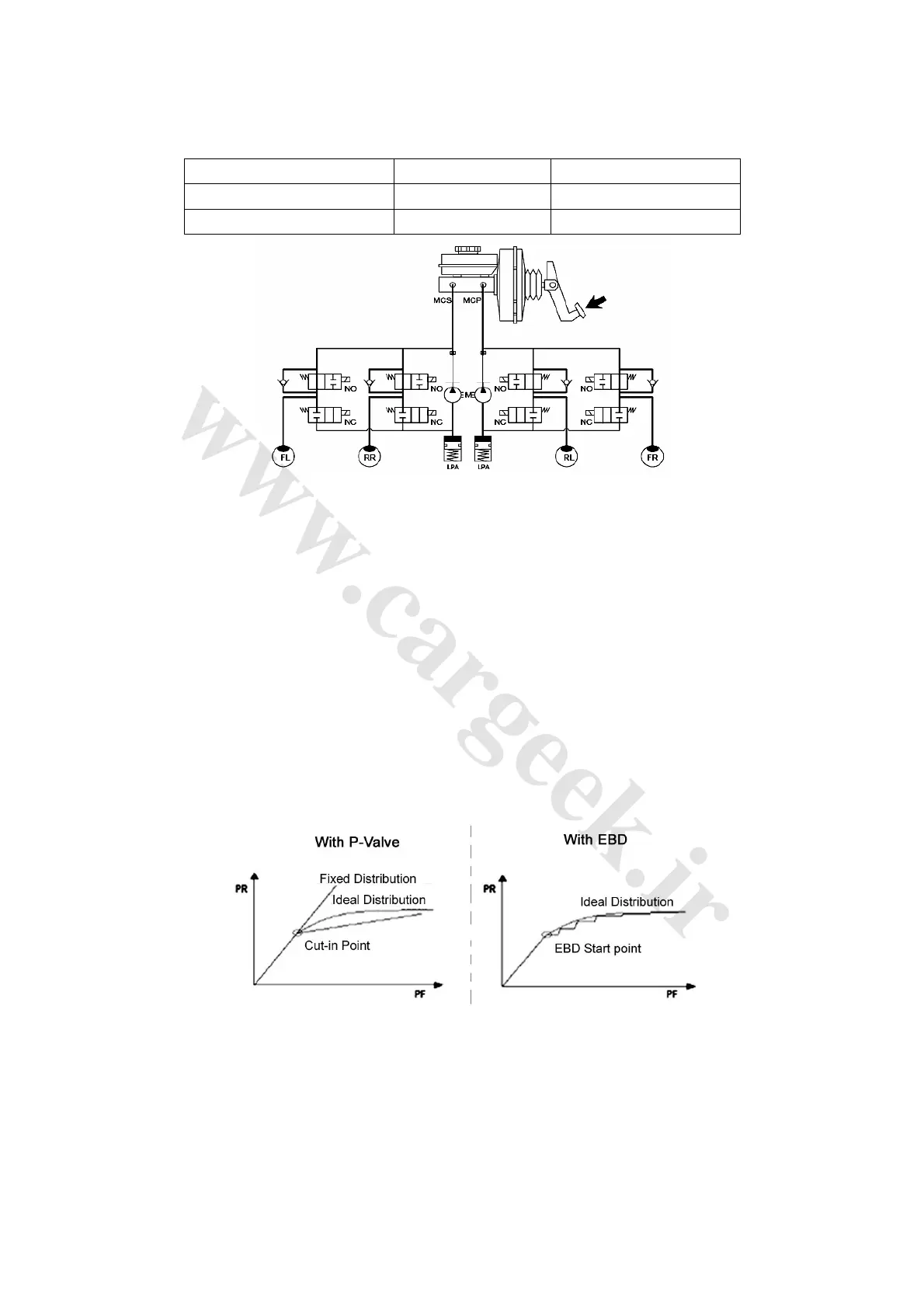
4. ABS operation (pressure increase) condition (Table 3-4 and Fig. 3-6).
Table 3-4
Solenoid valve Electricity Solenoid valve condition
Normally opened valve Off Open
Normally closed valve Off Closed
Fig. 3-6
When the pressure is decreased, if too much brake fluid is discharged or friction coefficient is
increased, the pressure to every wheel should be increased. ECU will send HCU a signal of
pressure increase to wheel. In order to increase the pressure of wheel slave cylinder, the normally
opened valve will open and the normally closed valve will close. In case of pressure decrease, the
brake fluid in LPA will flow out under the pressure increase condition with rotation of motor and
then into wheel slave cylinders through the master pump and the normally opened valve. HPA
between LPA and master pump will decrease the high pressure pulse produced by oil pump with
the help of metering jet fluid resistance.
Concerning operations described in item 2-4 above, ABS will work until the vehicle has been
completely stopped according to locking condition, so as to guarantee the safety and steering
performance.
III. EBD Control Mode (Fig. 3-7)
Fig. 3-7
EBD is to guarantee the operation stability. Rear wheel will be stopped after front wheel. As front
brake does more work than rear brake, the rear wheel will stop first if it receives equal pressure. In
order to prevent it, the equipment, pressure reducing valve (P-Valve), to decrease the pressure of
rear wheel is needed. A special P-Valve is not necessary for the vehicle with ABS, as ABS can
control the rear wheel braking pressure with supplementary procedures and improve the operation
stability.



 To Next Page