Section IV Fault Diagnosis and Troubleshooting
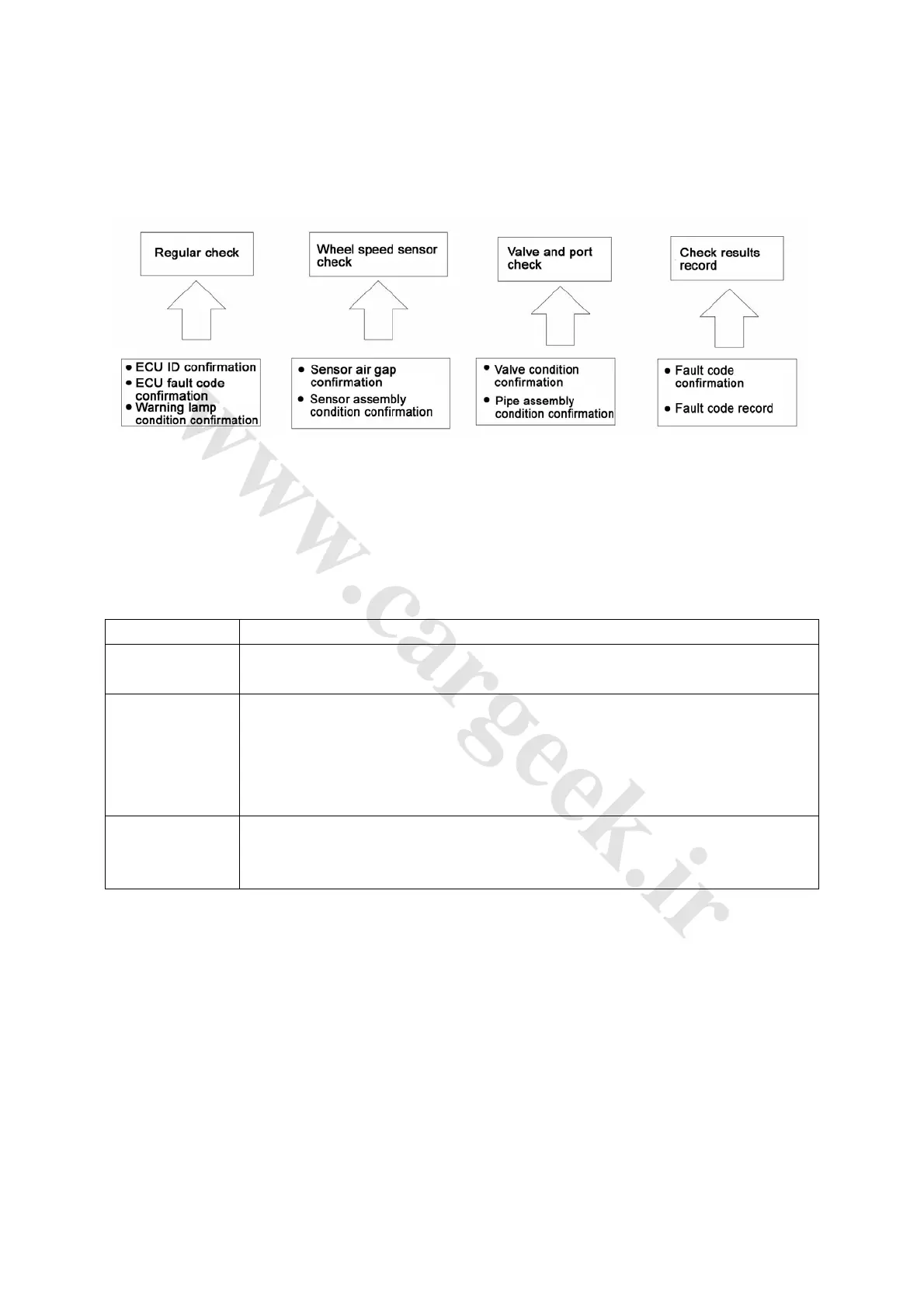
I. Fault Detection Procedure (Fig. 3-15)
Fig. 3-15
II. Notes on Fault Diagnosis (Table 3-5)
As ABS is controlled by the electronic hydraulic pressure, the phenomena in the following table
are normal under normal working condition of ABS, not faults.
Table 3-5
Phenomenon Description
System self-check
sound
Sometimes there will be sound like collision from the engine compartment after engine is
started. It is normal because it is caused by the ABS self-check.
ABS working
sound
1. Motor sound in ABS hydraulic unit;
2. Sound with brake pedal vibration;
3. Suspension impact sound caused by braking or screak caused by friction between wheel
and ground when ABS works.
Note: Wheel may screak when ABS is working normally.
ABS works, but
the braking
distance is long.
Sometimes the braking distance of the vehicle with ABS will be longer than that of the
vehicle without ABS on snow or sandstone road. The driver should be more careful when
driving on these roads.
III. Key Points on Maintenance of Dynamic Faults
Instantaneous poor contact may occur in the electronic control system, electrical circuit and signal
input and output areas, which may cause occasional dynamic fault or DTC during ECU self-check.
If fault cause continues, the abnormal part can be detected with reference to DTC table. As
sometimes fault cause vanishes itself, it is difficult to figure out the real cause.
In such a situation, faults can be simulated to check if the fault occurs again.
1. When vibration may be the main reason:
(1) Shake the connector lightly in all directions;
(2) Shake the harness lightly in all directions;
(3) Shake the sensor lightly in all directions;
(4) Shake the other moving parts (like wheel bearing) lightly.



 To Next Page