Date Code 20090715 User’s Guide SEL-421 Relay
Section 2
U.User’s Guide
Installation
The first steps in applying the SEL-421 Relay are installing and connecting
the relay. This section describes common installation features and particular
installation requirements for the many physical configurations of the
SEL-421. You can order the relay in horizontal and vertical orientations, and
in panel-mount and rack-mount versions. SEL also provides various
expansion I/O (input/output) interface boards to tailor the relay to your
specific needs.
To install and connect the relay safely and effectively, you must be familiar
with relay configuration features and options and relay jumper configuration.
You should carefully plan relay placement, cable connection, and relay
communication. Consider the following when installing the SEL-421:
➤ Shared Configuration Attributes on page U.2.1
➤ Plug-In Boards on page U.2.12
➤ Jumpers on page U.2.18
➤ Relay Placement on page U.2.30
➤ Connection on page U.2.31
➤ AC/DC Connection Diagrams on page U.2.50
It is also very important to limit access to the SEL-421 settings and control
functions by using passwords. For information on relay access levels and
passwords, see Changing the Default Passwords: Terminal on page U.4.9.
Shared Configuration Attributes
There are common or shared attributes among the many possible
configurations of SEL-421 relays. This section discusses the main shared
features of the relay.
Relay Sizes
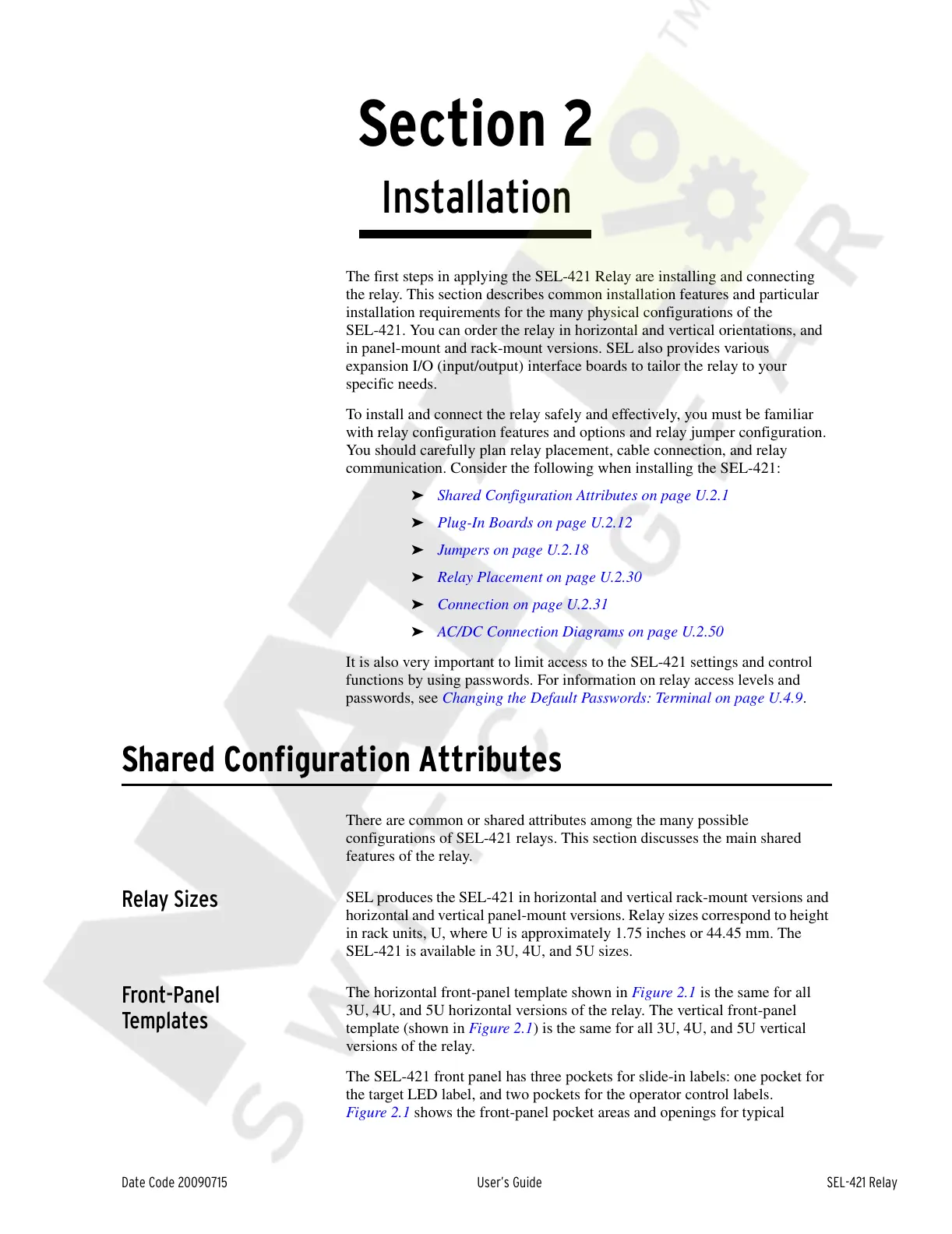
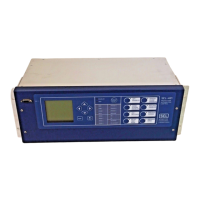
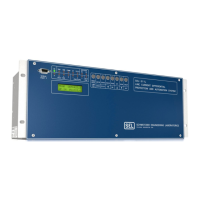
SEL produces the SEL-421 in horizontal and vertical rack-mount versions and
horizontal and vertical panel-mount versions. Relay sizes correspond to height
in rack units, U, where U is approximately 1.75 inches or 44.45 mm. The
SEL-421 is available in 3U, 4U, and 5U sizes.
Front-Panel
Templates
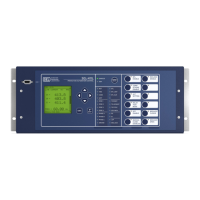
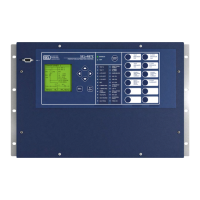
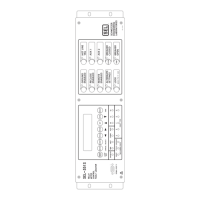
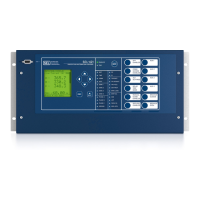
The horizontal front-panel template shown in Figure 2.1 is the same for all
3U, 4U, and 5U horizontal versions of the relay. The vertical front-panel
template (shown in Figure 2.1) is the same for all 3U, 4U, and 5U vertical
versions of the relay.
The SEL-421 front panel has three pockets for slide-in labels: one pocket for
the target LED label, and two pockets for the operator control labels.
Figure 2.1 shows the front-panel pocket areas and openings for typical
Courtesy of NationalSwitchgear.com


 To Next Page