R.2.45
Date Code 20111215 Reference Manual SEL-421 Relay
Auto-Reclosing and Synchronism Check
Voltage Checks for Auto-Reclosing and Manual Closing
Supervising Circuit
Breaker Closing with
Voltage Checks
Supervising Auto-Reclosing
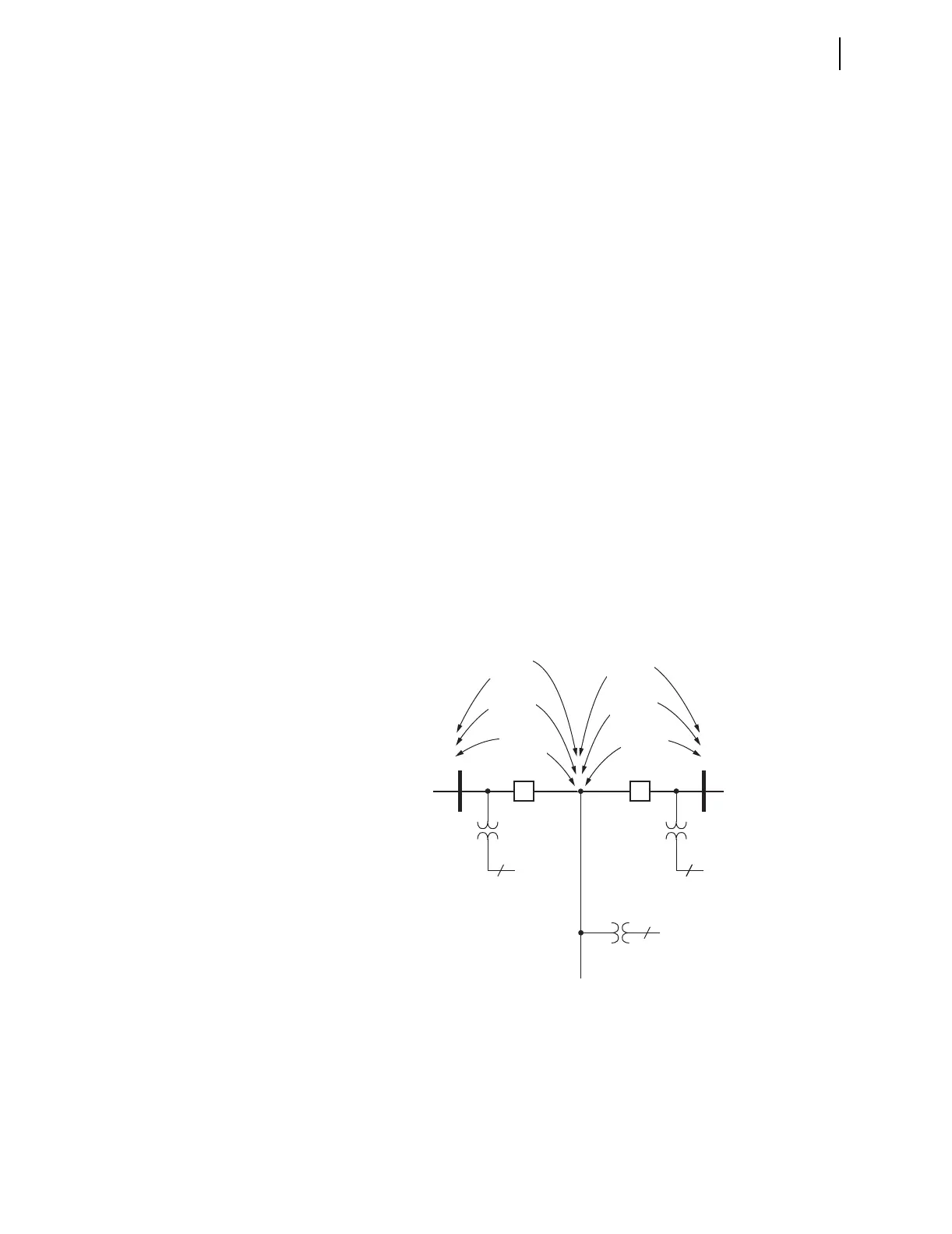
For a fault on the line in Figure 2.17, both breakers trip open and the lead
breaker recloses first. For example, presume the lead breaker closes only if its
respective bus is live and the line is dead (dead line/live bus; see Figure 2.17).
Then, after successful reclose of the lead breaker, the follower breaker closes
on synchronism check (see Figure 2.23). Such reclose supervision logic is
realized as follows for respective breakers BK1 and BK2:
3P1CLS := LEADBK1 AND DLLB1 OR FOLBK1 AND 25A1BK1 OR …
3P2CLS := LEADBK2 AND DLLB2 OR FOLBK2 AND 25A1BK2 OR …
Note that the lead breaker and follower breaker supervision (Relay Word bits
LEADBKn and FOLBKn, respectively) provides dynamic control for reclose
supervision. One, but not both of the breakers can reclose for a dead line/live
bus condition (lead breaker), while the other then closes for a synchronism
check condition (follower breaker).
Supervising Manual Closing
Voltage checks can also be used to supervise manual closing. For example,
presume that manual closing of breaker BK1 (Figure 2.17) should not be
allowed if the respective bus is dead (dead line/dead bus or live line/dead bus
condition):
BK1MCL := NOT(DLDB1 OR AND LLDB1) AND (…)
Figure 2.17 Voltage Check Element Applications
Bus 2
V
S1
(Bus 1 Potential)
V
S2
(Bus 2 Potential)
BK1 BK2
1 1
3
V
P
(Line Potential)
Dead Line/
Live Bus 2
(DLLB2)
Dead Line/
Dead Bus 2
(DLDB2)
Live Line/
Dead Bus 2
(LLDB2)
Dead Line/
Live Bus 1
(DLLB1)
Dead Line/
Dead Bus 1
(DLDB1)
Live Line/
Dead Bus 1
(LLDB1)
Bus 1
Line


 To Next Page