R.3.20
SEL-421 Relay Reference Manual Date Code 20111215
SELOGIC Control Equation Programming
SELOGIC Control Equation Elements
EXAMPLE 3.7 Conditioning Timer Programming and Operation
This example uses Protection Free-Form Conditioning Timer Seven,
PCT07. The free-form settings are as shown here:
PCT07PU := 5.3 # Pickup set to 5.3 cycles
PCT07D0 := 6.0 # Dropout set to 6.0 cycles
PCT07IN := IN101 # Operate on the first input on the main board
PSV29 := PCT07Q # Protection SEL
OGIC control equation variable follows the
timer output
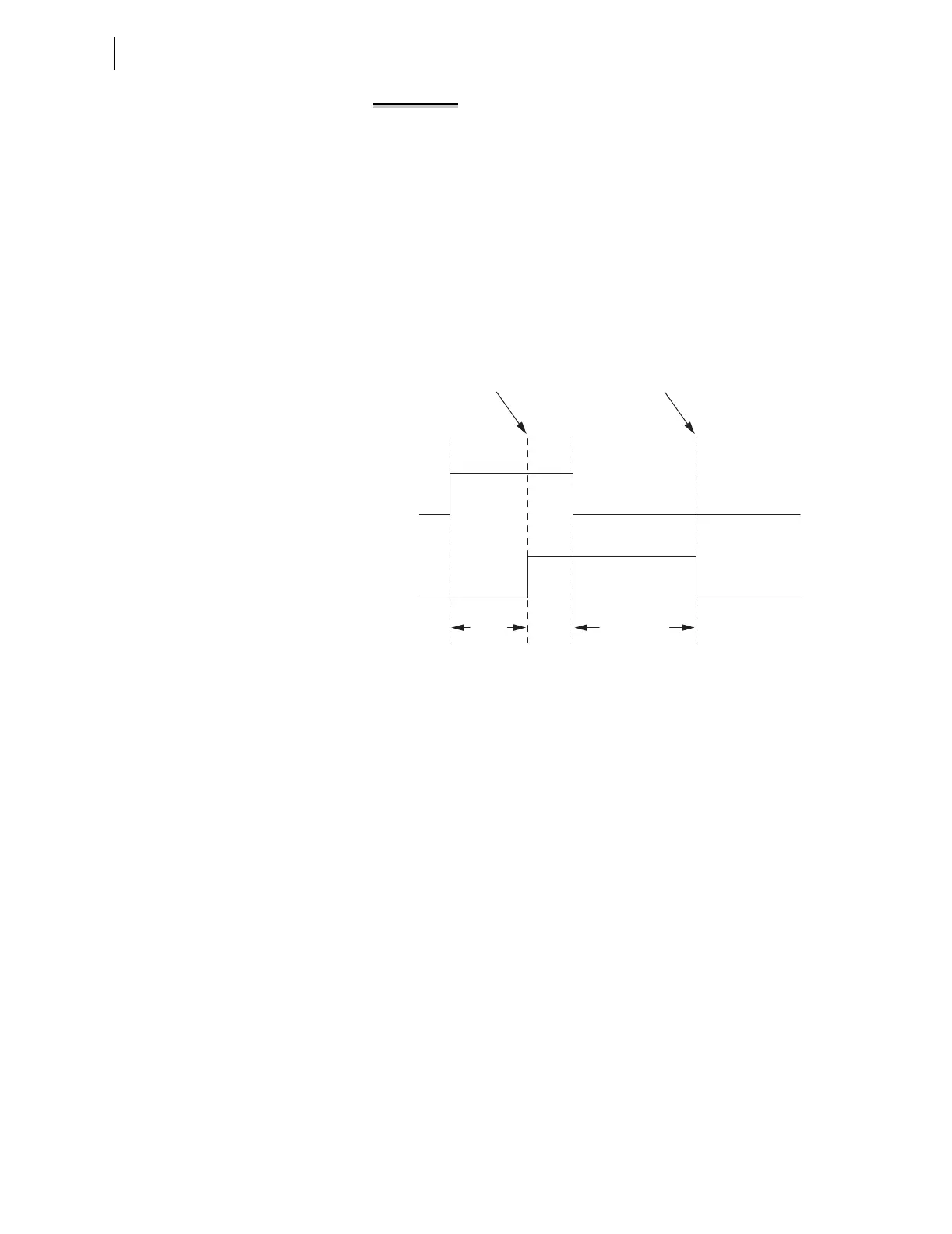
The operation of the timer when IN101 turns on for 7 cycles is shown
in the timing diagram in Figure 3.7. Because the pickup setting is an
uneven number of protection processing intervals (1/8 cycle), the
pickup occurs on the first 1/8th cycle after the Pickup Time of 5.3
cycles expires.
Figure 3.7 Conditioning Timer Timing Diagram for Example 3.7
In protection free-form programming, the relay evaluates the timer at
execution of the timer Input SEL
OGIC control equation (PCTnnIN). The relay
loads the Pickup Time (PCTnnPU) and Dropout Time (PCTnnDO) into the
timer when the relay observes the appropriate edge in the input. If you enter a
math expression for Pickup Time or Dropout Time, the relay uses the value
calculated before the Input SEL
OGIC control equation. If your Pickup Time or
Dropout Time equation is below the Input equation (has a higher expression
line number), the relay will use the value calculated on the previous SEL
OGIC
control equation execution interval. Because the relay calculates the last value
for pickup or dropout in this manner, we recommend for most applications
that you enter the Pickup Time, Dropout Time, and Input statements together
in the order shown in Example 3.7.
Sequencing Timers
Sequencing timers are useful for sequencing operation. There are two main
differences between sequencing timers and conditioning timers. First,
sequencing timers integrate pulses of the input to count up a total time.
Second, the elapsed time a sequencing timer counts is visible; you can use this
time in other SEL
OGIC control equation programming or make this time
visible through one of the relay communications protocol interfaces.
Sequencing timers are available in the protection free-form area and
automation free-form area as shown in Table 3.15. Sequencing timers have
three input parameters and two outputs listed in Table 3.16.
IN101
PSV29
DropoutPickup
Dropout Time
Pickup
Time
5.375 Cycles
6.0 Cycles


 To Next Page