R.2.62
SEL-421 Relay Reference Manual Date Code 20111215
Auto-Reclosing and Synchronism Check
Synchronism Check
“Slip—No
Compensation”
Synchronism Check
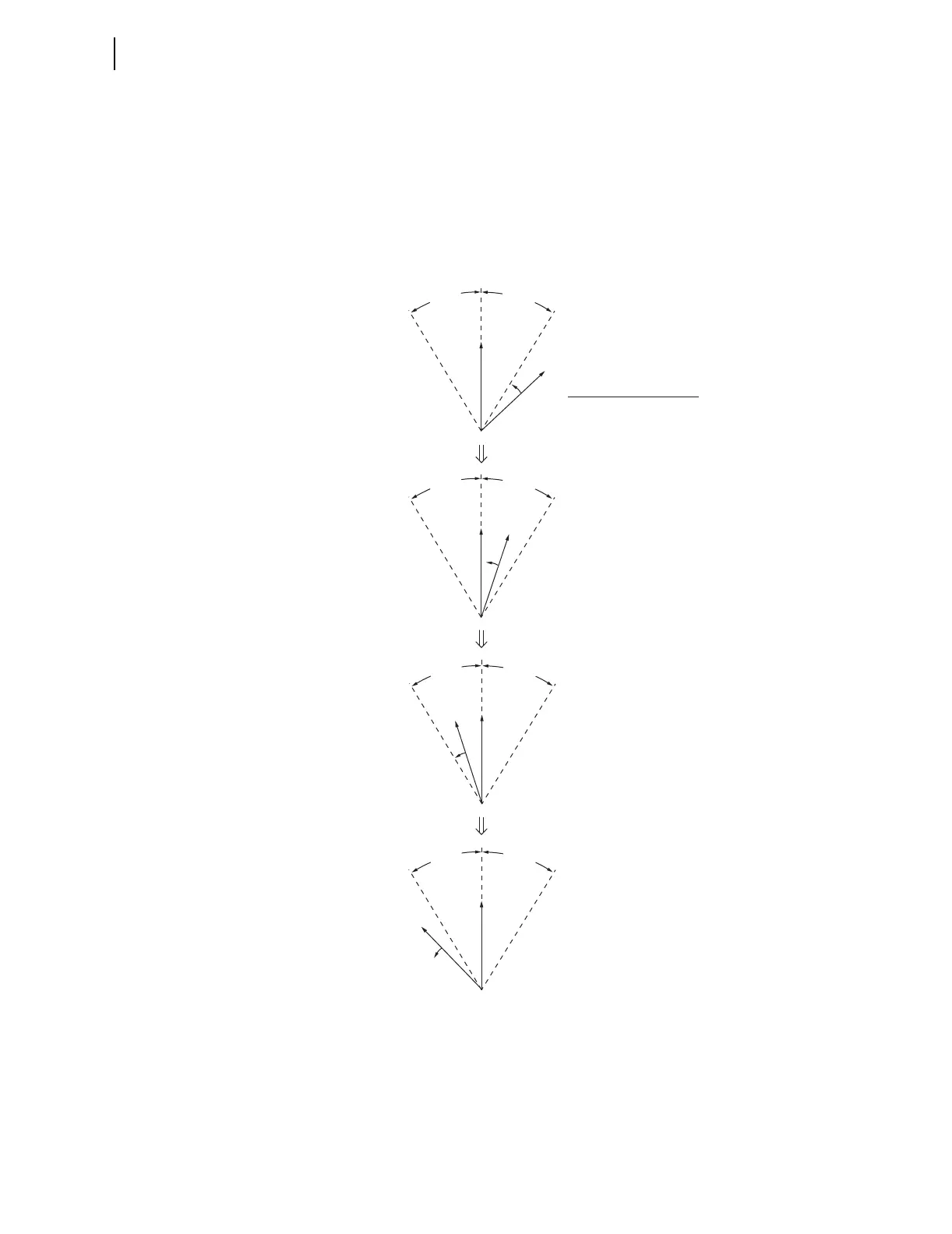
The four cases [(a), (b), (c), and (d)] shown in Figure 2.30 are “slip—no
compensation” cases for asynchronous systems (not paralleled). The cases
progress in time from top to bottom. The normalized synchronism-check
voltage source V
S1
slips with respect to synchronism-check voltage reference
V
P
. The indication of the rotation arrow on phasor V
S1
(and the time
progression down the page) shows that the system corresponding to V
S1
has a
higher system frequency f
S1
than the system corresponding to reference V
P
with system frequency f
P
. The slip frequency across Circuit Breaker BK1 is
f
S1
–f
P
.
Figure 2.30 “Slip—No Compensation” Synchronism-Check Element Output
Response
Positive Slip Frequency
If the slip frequency is positive, V
S1
is slipping ahead of reference V
P
(the
system corresponding to V
S1
has a higher system frequency than the system
corresponding to V
P
; f
S1
> f
P
). Positive slip frequency is the counter-
V
P
(a)
(b)
(c)
(d)
V
S1
V
P
V
S1
V
P
V
S1
V
P
V
S1
Slip (asynchronous systems—not paralleled).
Max slip frequency setting 25SFBK1 := OFF
Response of synchronism-check
element outputs (Relay Word Bits):
25W1BK1 = logical 1
25A1BK1 = logical 1
25W1BK1 = logical 1
25A1BK1 = logical 1
25W1BK1 = logical 0
25A1BK1 = logical 0
25W1BK1 = logical 0
25A1BK1 = logical 0
A
N
G
1
B
K
1
A
N
G
1
B
K
1
A
N
G
1
B
K
1
A
N
G
1
B
K
1
A
N
G
1
B
K
1
A
N
G
1
B
K
1
A
N
G
1
B
K
1
A
N
G
1
B
K
1


 To Next Page