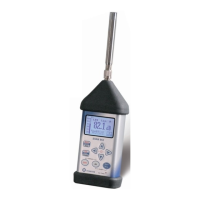
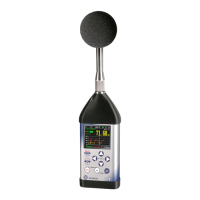
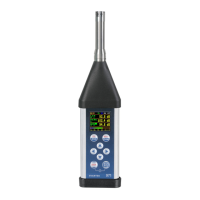
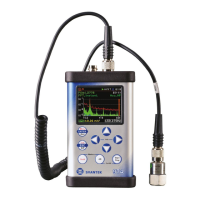
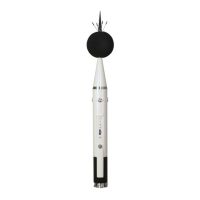
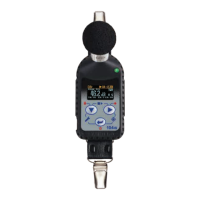
The user may set-up the I/O mode in the instrument’s screen <Menu> / System / Ext. I/O Setup:
1. If the instrument is switched off, the I / O port is ready to turn on the instrument (cf. the requirements for the
switching signal stated in 3.1 below).
2. If the instrument is turned on, three options are available:
a) Analog as standardized Output of the measured signal; one from four channels selected by the user.
b) Digital In as Input (SLAVE mode) used for the external triggering of the instrument (the parameters
of the triggering signal are stated in 3.2 below).
c) Digital Out as Output (MASTER mode) used for the external instruments triggering (the parameters
of the signal of the external triggering is stated in 3.3 below).
3. Specification of the external signals:
3.1. Parameters of the voltage impulse of the signal (Analog) for turning on the instrument:
a) recommended voltage range is +/- 12V (abs. max +/- 15V; the TRANSIL type internal limit of the
absolute voltage higher than 15V). If necessary higher voltage up to 30 V can be used. In this case
a serial resistor (from 5 to 10 kOhm) should be applied to the source of trigger signal
b) triggering level +1 V
c) triggering slope - uprising
d) minimal duration of the triggering signal - 100 msec (it means that the input signal higher than +1 V
should be applied for at least 100 msec).
e) input impedance - ca. 10 kOhm / 100pF. ESD type safety.
3.2. The slave input signal (Digital In) as the voltage impulse has the following parameters:
a) voltage range. level. impedance as in 3.1; it is not recommended to use the voltage higher than +/-
12 V (+/-1 V). additional serial resistances are not recommended either
b) minimal duration of the triggering impulse: 10 μsec
c) the triggering is done on the slope (falling or rising) of the triggering signal set by the user by passing
through +1 V threshold
d) next triggering is possible after 100 μsec from the end of the previous measurement
3.3. The master output signal (Digital Out) as the output impulse has the following parameters:
a) voltage: 0 V or 3 V
b) triggering slope: uprising or falling down set by the user
c) input impedance: 50 Ohm
d) duration of the impulse: ca. 10 μsec
4. The Digital Out mode has two different functions:
4.1. Function: Trigger Pulse. When this function is selected, the terminal [1] is set as output, which
enables one to trigger another instrument (one instrument or more with trigger inputs connected
together in parallel). The output trigger impulse meets specification given below:
a) trigger impulse is generated before every measurement,
b) output voltage range from 0 V or 3 V,
c) triggering slope: rising or falling,
d) output impedance: 51 Ω,
e) duration of the impulse: ca. 30 μsec.
4.2. Function: Alarm Pulse. When this function is selected, the terminal [1] is set as an output,
which changes its output level, when current result of measurement exceeds user-
programmable threshold level. In this case the terminal [1] output operates as an output of
analogue comparator with user-programmable threshold. This feature enables one to control an
external device as alarm-indicator or similar:

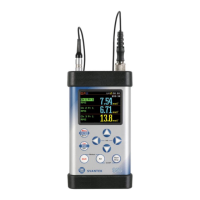

 To Next Page