3.2 CENTRIFUGAL SEPARATION 3 BASIC PRINCIPLES OF SEPARATION
16
3.2 Centrifugal Separation
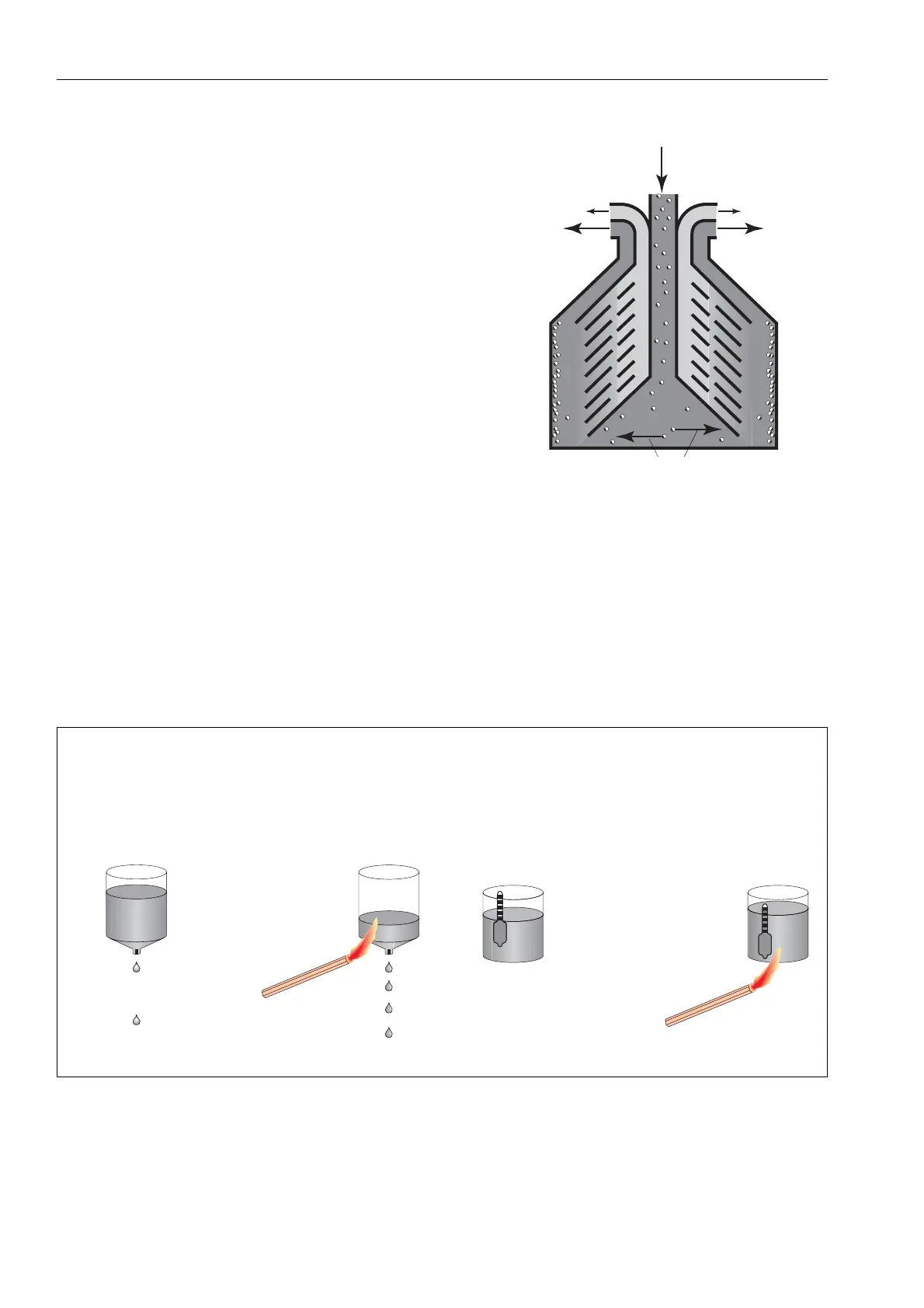
In a rapidly rotating bowl, the force of gravity
is replaced by centrifugal force, which is many
times greater.
Separation and sedimentation is continuous
and takes place very quickly.
The centrifugal force in the separator bowl can
achieve in a few seconds that which takes many
hours in a tank under influence of gravity.
The separation efficiency is influenced by
changes in the oil viscosity, separating
temperatures and in throughput.
3.3 Temperatures
For some types of process liquids (e.g.
mineral oils) a high separating temperature
will normally increase the separation
capacity. The temperature influences oil
viscosity and density and should be kept
constant throughout the separation.
Viscosity
Viscosity is a fluids resistance against movement.
Low viscosity facilitates separation. Viscosity can be
reduced by heating.
Density difference
Density is mass per volume unit. The greater the density
difference between the two liquids, the easier the
separation. The density difference can be increased by
heating.
G0870311
Lighter liquid
Heavier liquid
Centrifugal force
G0885911
High viscosity
Low viscosity
G0886011
High density difference.
Low density difference




 To Next Page