Safety instructions for operation in engine
compartment
Operating to the engine or in the engine
compartment (such as checking or adding fluids)
may result in safety hazards such as burns,
other personal injuries, fires or other accidents.
Therefore, pay attention to the relevant warning
instructions and safety regulations.
● If you open the engine hood while the
engine is overheating or the engine
compartment is on fire, you may be
exposed to high-temperature gases or
other leaking pressure fluids, posing a risk
of personal injury. Engine hood cannot be
closed until the overheated engine has
been cooled down. If the engine
compartment is on fire, keep the engine
hood closed and notify the firefighters
immediately.
● Check the vehicle for engine oil leakage.
Avoid any fluid dripping onto the high-
temperature engine or exhaust;
otherwise, there is a risk of fire.
● While adding a fluid, do not mix the fluid
with any other fluid; otherwise, it may
cause serious malfunction of the vehicle.
● Before operating underneath the vehicle,
ensure that the vehicle does not move
and that it is reliably supported by suitable
stands. If the vehicle is only supported by
a vehicle jack, it is not safe to operate
un er the vehicle.
● Do not unlock the engine hood while
driving; an unlocked engine hood may
open while the vehicle is in motion,
obscuring the driver's view and causing a
serious accident.
● Make sure the windshield wipers are
attached to the windshield before opening
the engine hood. Otherwise, the
windshield wipers or engine hood may be
damaged.
● Take care not to pinch any person or
object when closing the engine hood.
● There is high voltage while the ignition
system and fuel injection system are
operating. So do not touch the live parts
to avoid electric shock and risk of
personal injury.
● Some parts in the engine compartment
(such as radiator fan) may continue to run
or suddenly run again even after the
ENGINE START/STOP button is set to
OFF position. There is a risk of personal
injury. If it is inevitable to operate on parts
in the engine compartment, you should:
- Set the SSB to “OFF” position;
- avoid touching the danger area around
any operating component, such as the
rotating area of the fan.
- remove all ornaments and watch.
- keep clothing, hair, etc. away from any
moving part.
Inspecting and adding engine coolant
The coolant can play the role of corrosion,
cavitation, leakage, radiator boil, scaling and
freezing prevention. It can keep the cooling
system in the best working condition and ensure
the normal working temperature of the engine.
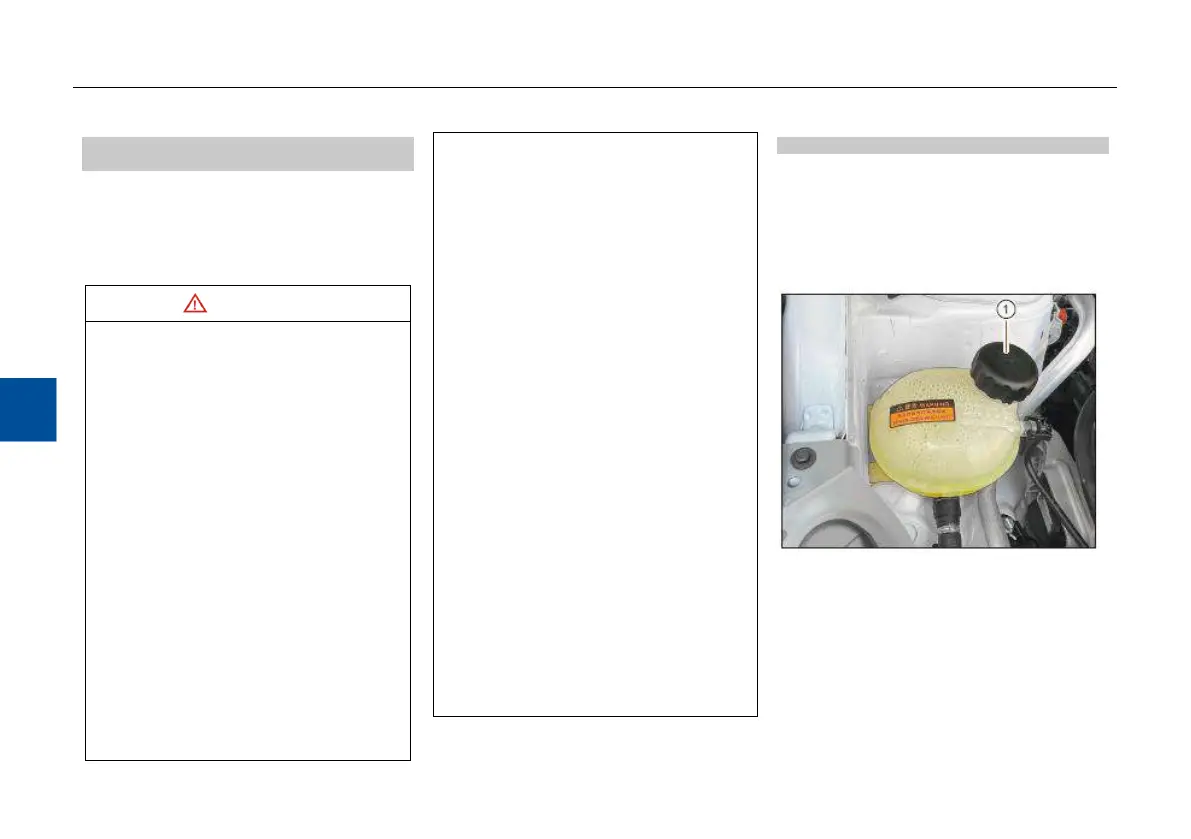
Inspecting engine coolant level and adding
engine coolant
MAX: upper limit MIN: lower limit
Inspect the coolant level after the engine is
cooled down.
A MIN scale and a MAX scale are provided on
the coolant reservoir. If the coolant level is below
the MIN scale, please add coolant to the level
near the MAX scale. (See page 288 for the
recommended coolant type)



 To Next Page