Need help?
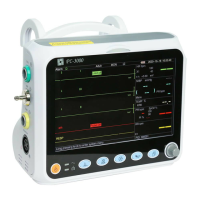
Do you have a question about the Gima PC-3000 and is the answer not in the manual?
Basic safety information for monitor operation.
Symbols and icons used on the device.
Product name, intended use, and features of the monitor.
Description of the monitor's front panel and controls.
Layout and components of the monitor's display screen.
Procedures for setting up and installing the device.
Initial steps for powering on and preparing the monitor.
Procedure for safely shutting down the monitor.
Navigating and operating the monitor's main menu.
Process for transferring data from the monitor to a computer.
Display of SpO2 trend data in a list format.
Visualizing trends of monitored parameters over time.
Reviewing previously recorded waveforms for analysis.
Accessing and configuring system settings and options.
Managing patient data and files on the monitor.
Using the built-in calculator for medicine dosages.
Configuring general system parameters like type, mode, and language.
Configuring ECG monitoring parameters like gain, speed, and filter.
Configuring NIBP measurement parameters like limits and modes.
Configuring respiration monitoring parameters like gain and apnea settings.
Classifying alarms into physiological, technical, and prompt messages.
Visual and audible indicators used for alarm notifications.
How to review and set alarm limits for parameters.
Steps to take when an alarm condition is detected.
Safety precautions specific to ECG monitoring.
Steps to prepare the patient and device for ECG monitoring.
Adjusting ECG monitoring parameters like lead, gain, and mode.
Features for detecting and learning cardiac arrhythmias.
Safety precautions specific to respiration monitoring.
Adjusting respiration monitoring parameters like gain and speed.
Safety precautions specific to NIBP measurement.
Steps to prepare for and perform NIBP measurements.
Adjusting NIBP monitoring parameters.
Safety precautions specific to SpO2 monitoring.
Guidelines for properly using SpO2 probes and sensors.
Adjusting SpO2 and Pulse Rate monitoring parameters.
Safety precautions specific to temperature monitoring.
Procedures for taking temperature measurements using the device.
Adjusting temperature monitoring parameters.
The default screen layout for remote observation mode.
Display showing only multiple ECG waveforms.
Display showing key monitored parameters and their values.
General information about the monitor's built-in battery.
Guidelines for maintaining the battery's performance and lifespan.
Procedures for cleaning the monitor and its accessories.
Procedures for disinfecting the monitor and accessories.
Daily checks to ensure the monitor is in good working condition.
Periodic inspection and maintenance of the monitor.
Verifying the accuracy of NIBP pressure measurements.
Technical specifications related to ECG monitoring.
Technical specifications related to NIBP monitoring.
Technical specifications related to SpO2 monitoring.
Recommended operating conditions for the device.
Steps to resolve issues when the screen has no display.
Troubleshooting ECG signal interference or baseline issues.
Diagnosing and resolving common alarm issues.
Explaining status and error messages during device operation.
The monitor's essential performance in electromagnetic environments.
Important warnings regarding electromagnetic compatibility.
 General
| Category | Medical Equipment |
|---|---|
| Channels | 3 |
| Display | LCD |
| Parameters | ECG |
| Power Supply | AC |

 To Next Page