16
SF9390
■ Paper type
• The following paper types are usable:
46 g/m
2
to 210 g/m
2
(12-lb bond to 116-lb index)
■ To prevent paper jams and paper feeding
failures
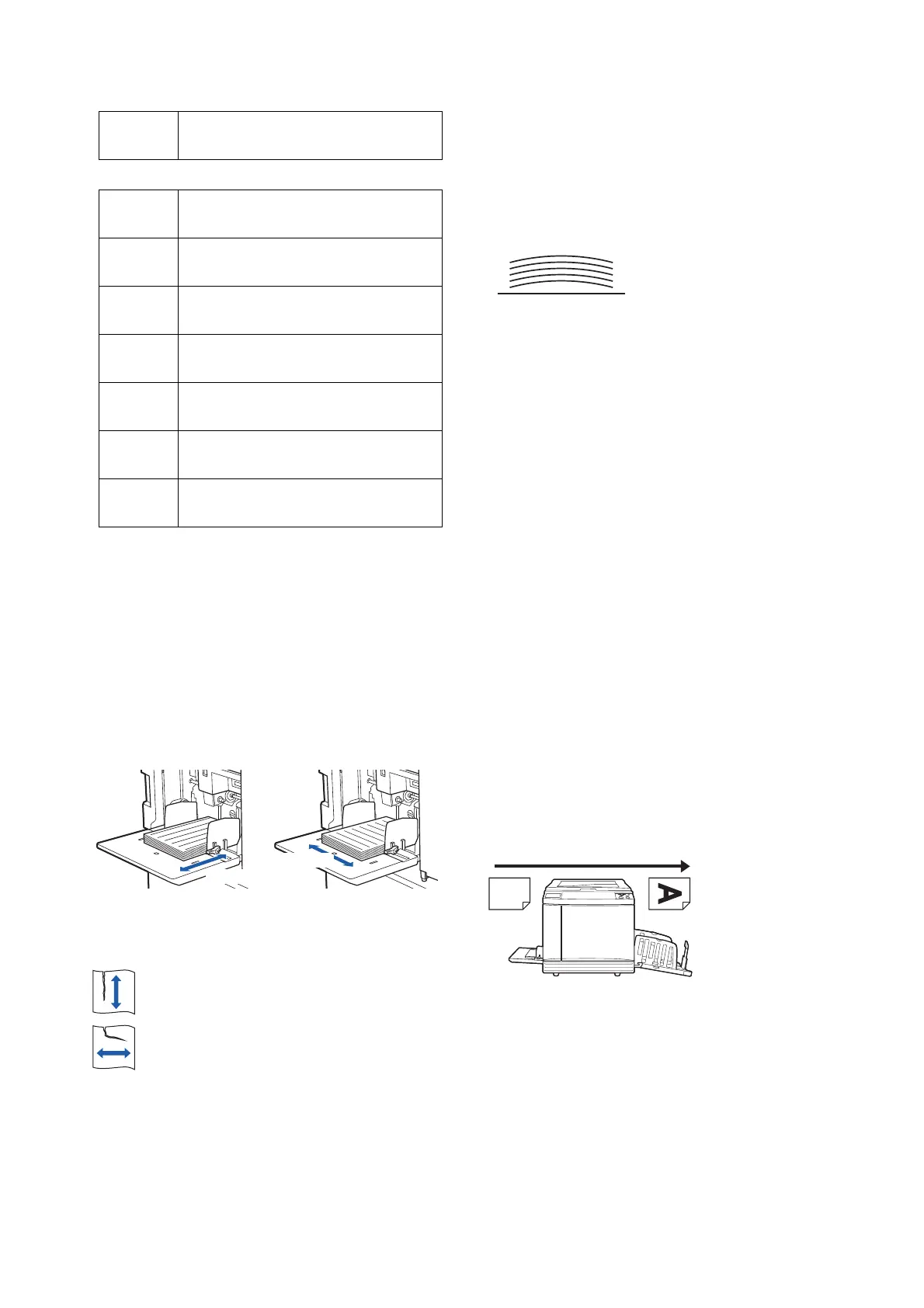
• Place the paper so that its grain (flow of the grain) is
aligned with the paper feeding direction.
If the paper grain is set perpendicularly to the paper
feeding direction, the resilience of the paper will
decrease, and it may result in a paper jam.
You can check the paper grain by tearing the paper.
The direction in which the paper tears straight is the
paper grain.
• When using poorly cut paper or coarse surfaced
paper (drawing paper, etc.), separate the paper
before use.
• Depending on the type of paper to be used, paper
dust may be generated during use of this machine.
Please clean and ventilate the area adequately.
• When using thick paper (drawing paper, etc.) or
paper with a slippery surface, adjust the paper feed
setting lever or paper arranger for the paper receiv-
ing tray.
(A 32 “Preparation before Printing”)
• Use flat paper. If it is unavoidable to use curled
paper, place the printing paper so that the inner
curled part faces up.
• If the margin at the top of the printed paper (leading
edge in the paper output direction) is too small or if a
highly dense image is located at the top of the
printed paper, the paper may adhere to the print
drum (cylinder). In this case, lower the print position
to allow a larger margin at the top or rotate the top-
and-bottom direction of the original, and then make
a master again.
■ Paper storage
Store paper in a dry area. Paper containing moisture
can result in paper jams or poor print quality.
■ Inappropriate paper for printing
Do not use the types of paper listed below, as it can
result in a paper jam.
• Extremely thin paper
(less than 46 g/m
2
[12-lb bond])
• Extremely thick paper
(greater than 210 g/m
2
[116-lb index])
• Chemically treated paper (such as thermal or carbon
paper)
• Excessively wrinkled, curled, creased, or torn paper
• Paper coated on one side or both sides
• Deckle-edged paper
• Art paper
• Paper with sticky areas or holes
■ Direction of paper
The leading edge in the paper feeding direction is
referred to as the “top” in this guide.
Statement
p
5 1/2 inches × 8 1/2 inches
A3p 297 mm × 420 mm
(11 11/16 inches × 16 17/32 inches)
A4p 210 mm × 297 mm
(8 1/4 inches × 11 11/16 inches)
A4n 297 mm × 210 mm
(11 11/16 inches × 8 1/4 inches)
B4p 257 mm × 364 mm
(10 1/8 inches × 14 11/32 inches)
B5p 182 mm × 257 mm
(7 5/32 inches × 10 1/8 inches)
B5n 257 mm × 182 mm
(10 1/8 inches × 7 5/32 inches)
Foolscap
p
215.9 mm × 330.2 mm
(8 1/2 inches × 13 inches)
The paper tears straight if you tear it along
the paper grain.
The paper does not tear straight if you tear it
perpendicularly to the paper grain.
RIGHT WRONG
Paper grain
Paper grain
(Top)



 To Next Page