Metering
166 APOLLO
Digital Broadcast Production Console
LOUDNESS METERS
Loudness meters provide a way
to monitor and regulate average
loudness levels over the duration of a
programme.
16 loudness meters are available to freely
assign to any source or output. Loudness
meters can be assigned to TFT meter
panels using the method described within
“TFT Meters” on page 160. The Meter
Setup screen in the main application
displays how many loudness meters are
available at any time.
Loudness metering at different
sample rates
From version 8.0 the desk can be
configured to operate at different sample
rates such as 48kHz & 96kHz.
At the higher sample rate the number of
loudness meters is halved, meaning that 8
Loudness meters are available at 96kHz.
instead of 16 Loudness meters at 48kHz.
Loudness Metering Modes
There are four loudness metering modes
available on the console, the details of
which are displayed in a table on the
following page. The loudness meter
mode is set globally for the console; select
>Show Settings>General Settings
within the main application and select a
metering mode from the button selector.
An appropriate loudness metering scale
can also be set from this screen, which
alters the scale of all loudness meter bar
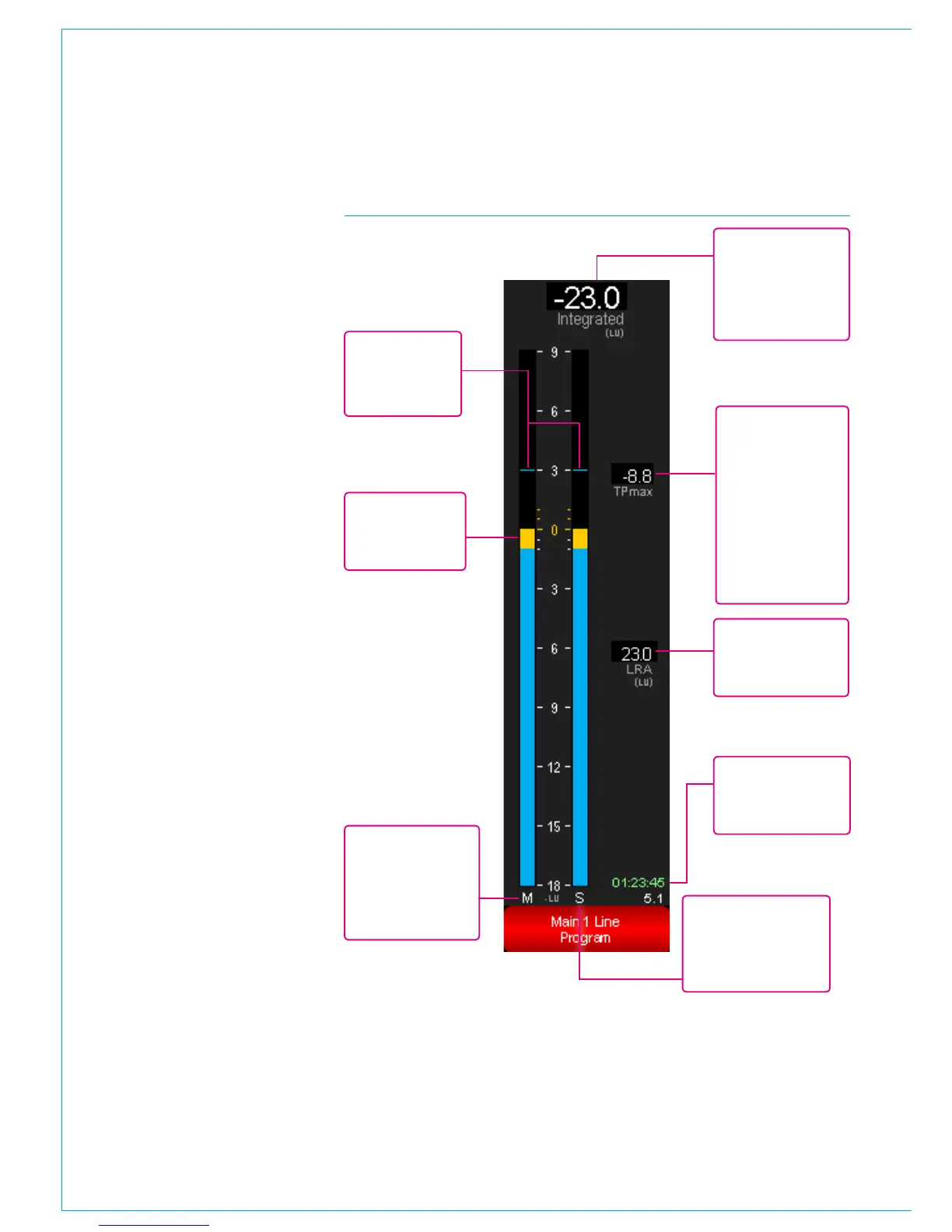
graphs - the example shown in Fig 1 on
the right is displaying EBU mode with
+9...-18 LU scale.
Loudness meter modes relate to
standards set by organizations in different
geographical regions. EBU (European
Broadcasting Union) relates to Europe,
ATSC (Advanced Television Systems
Committee) to North America and ARIB
(Association of Radio Industries and
Businesses) to Japan. These are currently
the main standards and are being widely
adopted in other geographical regions.
See Fig 3 on the next page for a table of
Loudness Metering Modes.
Integrated Loudness
- Gated measurement
as described in ITU-R
BS.1770. Turns red if
the signal exceeds the
target level variance
Short Term Loudness
- measures loudness
over a 3s time period.
This measurement is
not gated
Momentary
Loudness measures
loudness over a 0.4s
time period. The
measurement is not
gated
Max True Peak -
Represents the
maximum absolute
level of the signal in
the continuous time
domain (dBTP). Turns
red if TP Max for the
selected mode is
exceeded. Displays
--,- if TP Max is below
-48 dBTP
Loudness range -
Variation in loudness
within the current
metering period
Loudness metering
measurement duration
- the current metering
period
Target Loudness
level and variance
represented by area
shaded in yellow
Highest Loudness
level recorded
within the current
metering period
FIG 1 - LOUDNESS METER - DESCRIPTION OF COMPONENTS
• The current metering period refers to the period since the meter(s) were last reset.
• A gated measurement is calculated ignoring signals below the gate threshold.


 To Next Page