CDM-840 Remote Router MN-CDM840
Appendix H Revision 3
H–7
H.2.3 Configure Header and Payload Compression Refres h R ates
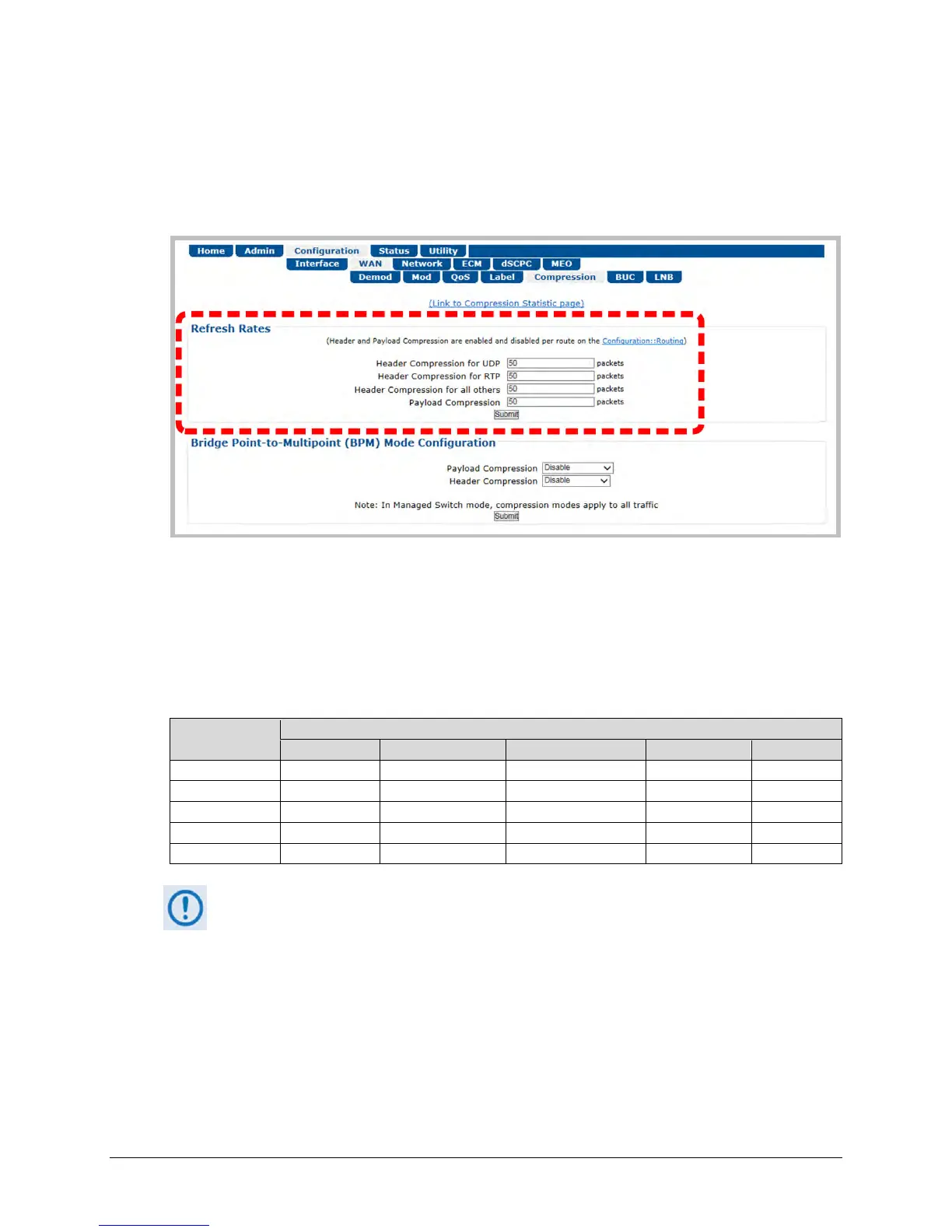
Use the ‘Configuration | WAN | Compression’ page (Figure H-3) to define the Header and
Payload Compression Refresh Rates. These settings control how many compressed header
packets are sent before a single full header packet is sent.
Figure H-3. Configuration | WAN | Compression Page
The supported refresh rates are based on the runtime characterization that there will be, at
most, 600 packets seen between refreshes. Additionally, even though the runtime supports
64,000 Tx compression sessions, it is only necessary to have context storage for a small number
over those 600 packets. Based on this specification, the CDM-840’s compression performance is
defined in Table H-3 (±5% with different compression refresh rates).
Table H-3. Compression Performance
Packet Size
% Savings per Compression Refresh Rate
While some compressed header traffic can be lost during deteriorated satellite link
conditions, the CDM-840 tries to minimize that when Adaptive Coding and
Modulation (ACM) is enabled (
Figure H-4). Sending a full packet allows the return of
the traffic stream; you may increase the Refresh Rate (smaller value) when poor
satellite link conditions are prevalent or, conversely, decrease the rate (larger value)
under clear sky condition operations.



 To Next Page