Need help?
Do you have a question about the Comtech EF Data CDM-760 and is the answer not in the manual?
Provides installation and operation information for the Comtech EF Data CDM-760 Modem.
Details patents, trademarks, warnings, cautions, notes, and recommended standard designations.
Covers electrical safety, installation, operating environment, and EU directives compliance.
Introduces the CDM-760 modem, its capabilities, and supported waveforms like DVB-S2.
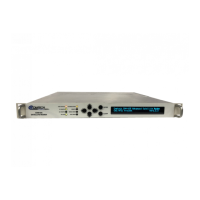
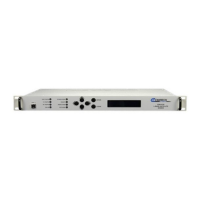
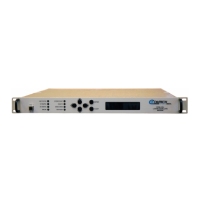
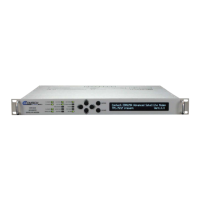
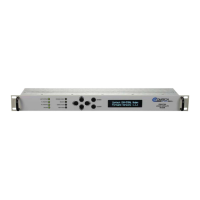
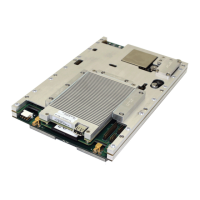
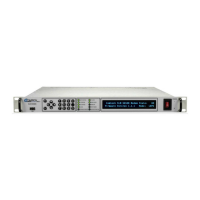
Describes the physical characteristics, standard, and optional assemblies of the CDM-760 modem.
Details system specifications including symbol/data rates, environmental, physical, and test functions.
Provides considerations before proceeding with firmware updates and file acquisition.
Details user-supplied items, PC connections, and terminal emulator configuration.
Covers the procedure for uploading firmware files via Command-line or HTTP.
Explains Comtech EF Data's FAST technology for enabling optional modem features.
Details how to activate FAST options using the front panel or HTTP interface.
Describes the front panel features including LED indicators, keypad, and VFD.
Details the primary and nested menus available for configuring and monitoring the modem.
Introduces Ethernet-based remote product management protocols like SNMP, Telnet, and HTTP.
Details the web interface for full monitor and control of the CDM-760.
Introduces serial-based remote product management and its assumptions.
Provides tables of remote commands and queries for various modem parameters.
Explains procedures for updating obsolete firmware versions of the CDM-760.
Details the prerequisites and steps for uploading firmware via Ethernet FTP.
Describes how to measure receive Es/No using a spectrum analyzer.
Introduces optional PIIC data modules and their rear panel slots.
Summarizes specifications for G.703, OC-3, STM-1, and DVB ASI PIIC modules.
Discusses Ethernet-based data handling and redundancy configurations.
Explains the function of Ethernet switches and routers in network connectivity.
Introduces information on Ethernet data traffic, operation, and metrics.
Lists status items and details for BER Testing, ACM Modulator/Demodulator, and CnC Status.
Introduces the High-Speed Packet Processor and its features like Header Compression and QoS.
Details operational overview and configuration methods for the Packet Processor.
Explains ACM as a technique for automatic modulation and FEC rate changes based on link conditions.
Details ACM configuration and monitoring via front panel, HTTP, or serial interface.
Introduces CID as a means to combat RF interference using MetaCarrier technology.
Describes Carrier ID configuration and operation via front panel, HTTP, or serial interface.
Introduces DoubleTalk Carrier-in-Carrier (CnC) for bandwidth and power utilization optimization.
Discusses CnC processing, link impairments, and operational requirements.
Explains Quality of Service (QoS) for traffic filtering and shaping with the Packet Processor.
Details the three processes of traffic shaping: Classification, Prioritization, and Drain.
Introduces Dynamic Predistortion (DPD) for optimizing satellite communication efficiency.
Outlines operational requirements for applying DPD remotely and locally.
Covers finding FEC, modulation, and power combinations for optimal bandwidth utilization.
 General
| Modulation | QPSK, 8PSK, 16-QAM, 32-QAM, 64-QAM, 8-QAM |
|---|---|
| FEC | LDPC, Turbo Product Code (TPC) |
| IF Frequency | 50 to 180 MHz |
| Frequency Range | 950 to 2150 MHz |
| Interface | G.703, HSSI, Ethernet (10/100Base-T) |
| Input Power | 100 to 240 VAC, 50/60 Hz |
| Operating Temperature | 0 to 50°C |
| Dimensions | 1.75" H x 19" W |

 To Next Page