Appendix G Revision 4
CDM-760 Advanced High-Speed Trunking Modem MN-CDM760
G–10
The default Target Es/No Margin is 1.0 dB.
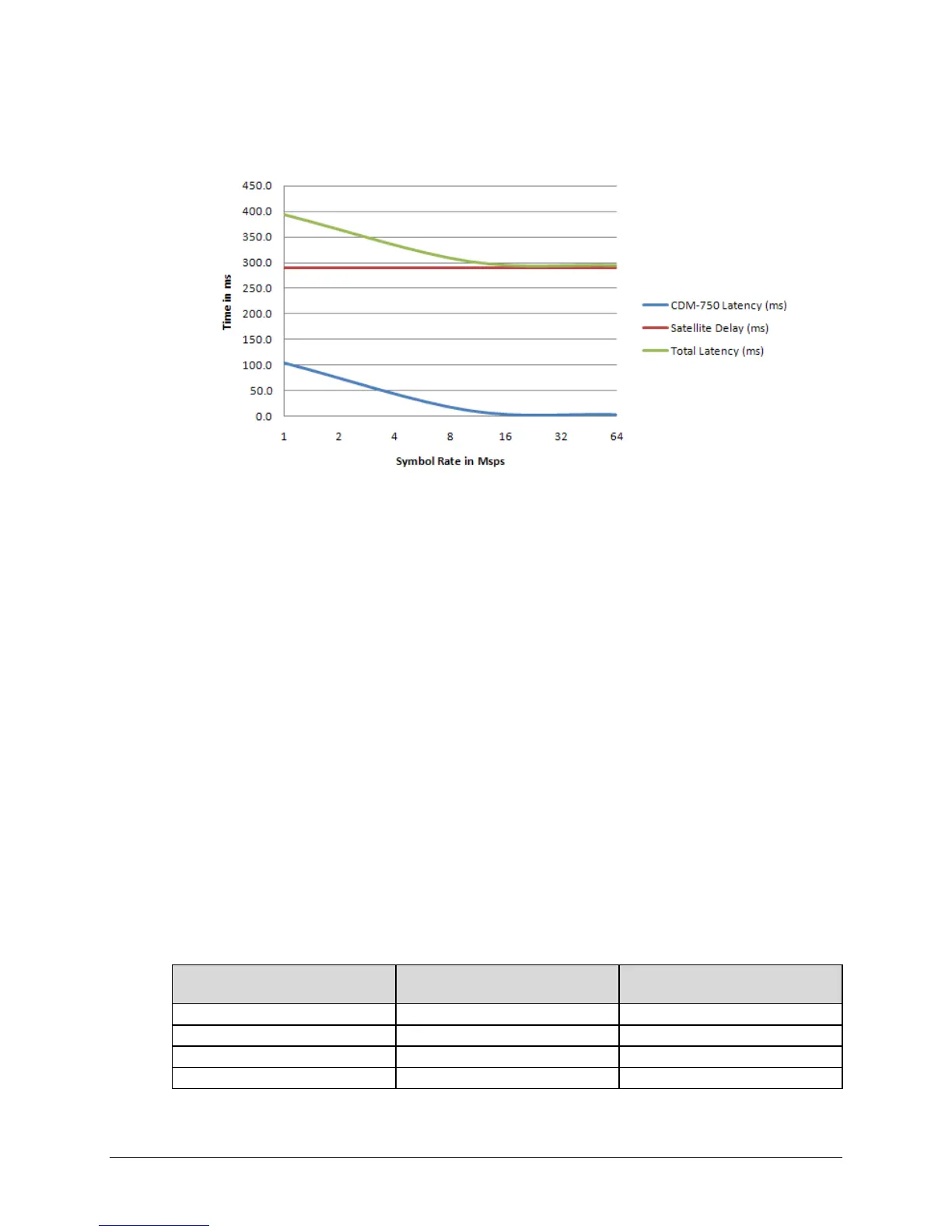
Figure G-4. Single Hop Latency
G.4.2 Distortion Adaptation / Modulation Type Impairment
Distortion is a very serious impairment, particularly for ModCods using 16APSK and 32APSK.
These higher order modulations rely on amplitude modulation (AM) and phase modulation (PM)
compared to ‘phase only’ modulations such as QPSK/8PSK. The amplitude modulation gives rise
to AM/AM and AM/PM distortion when operating near the satellite amplifier compression limit.
To compensate, you may enter additional impairments by modulation type; this allows correct
parameter adjustment in cases of additional degradation when a transponder is operated close
to saturation.
This distortion also penalizes higher-order ModCods (16APSK and 32APSK) much more than
QPSK/8PSK. The default for all degradation values is 0.0dB – when operating in the linear
portion of the ground amplifier and satellite amplifier segment, degradation should be minimal
and can be left at 0.0dB for most applications.
The additional impairment allows programming of an offset for each DVB-S2 constellation type,
which will ideally match the estimated satellite link distortion. These impairments apply to the
forward (transmit) link. The factors are added to CDM-760 specified Es/No for a given
constellation. Table G-4 describes the impairment entry.
Table G-4. Modulation Type Impairment
Additional Impairment Variable Name
dB (Factory Default Shown)
Adjustable 0.0 to 9.9 dB
Note: Impairment Setting – QPSK ≤ 8PSK ≤ 16APSK ≤ 32APSK


 To Next Page