Inspecting tire pressure
General description
Proper tire pressure can extend the service life
of the tire while improving the driving comfort,
fuel economy and operating stability of the
vehicle.
A low tire pressure will aggravate the tire wear,
greatly affect the operating stability and fuel
economy of the vehicle, and increase the risk of
tire failure. A high tire pressure will cause the
vehicle to run unstably and the tires are
unevenly worn, which may reduce the service
life of the tire.
Inspect the tire pressure, including tire pressure
of spare wheel, at least once a month, and
inspect it after driving on rough terrain or before
long-distance driving.
Always inspect the tire pressure after the tire has
cooled down. Cold tires mean that the vehicle
has not been driven for at least 3 h or traveled
not more than 1.6 km.
Please refer to the “Tire Information Label” for
cold tire pressure criteria.
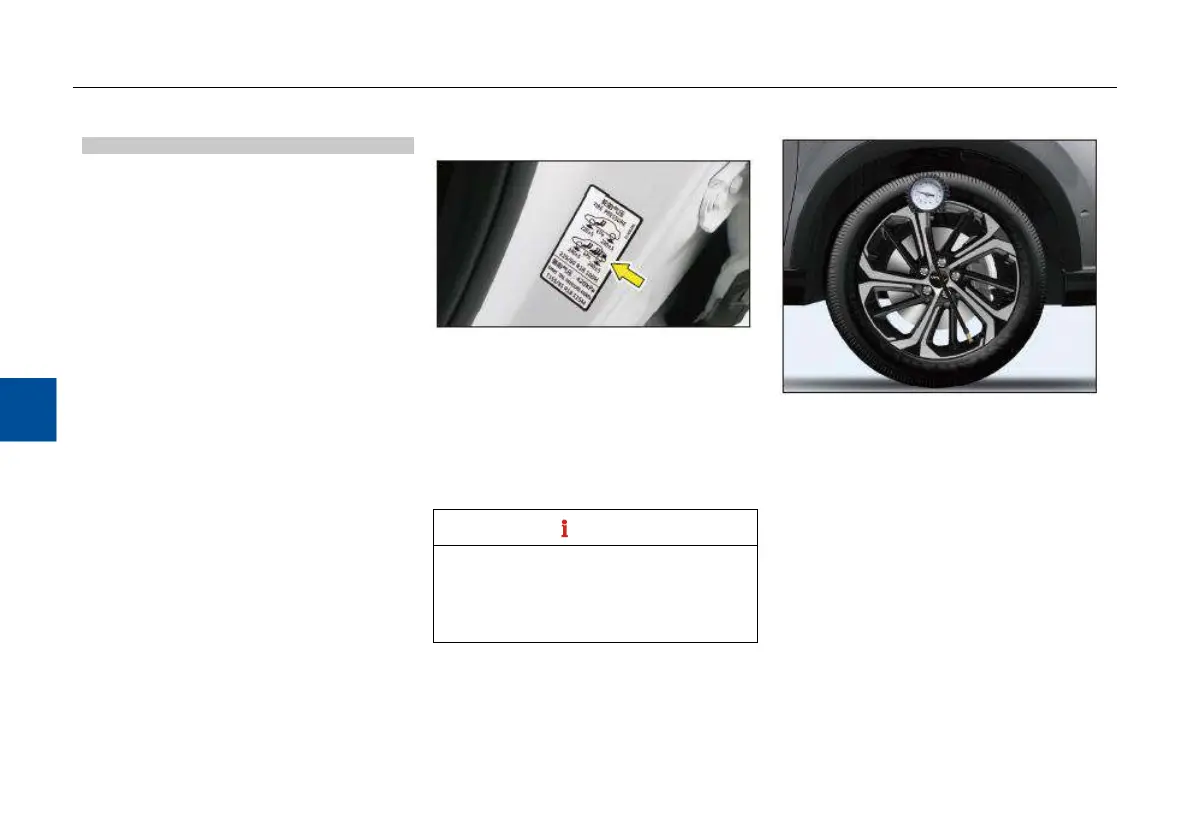
Tire information label
A data label for the tire information is attached to
the driver's side B-pillar in which the specified
tire pressure should be observed when inflating
the tire.
Inspecting tire pressure
The tire pressure shall be inspected with a tire
pressure gauge when the tire is cold.
1. Remove the valve cap from the tire valve and
inspect the valve for leaks with the soap solution.
Appropriate amount of household washing
liquid can be added in the clear water and
then the mixture can be applied to the valve;
afterwards, observe whether any bubbles are
generated, if so, it means air leak occurs.
2. After the tire pressure gauge is installed on
the valve, the tire pressure will be displayed on
the tire pressure gauge;
3. Inspect and adjust the tire pressure until it
reaches the standard value. Please refer to the
“Tire Information Label” on page 256 for tire
pressure criteria.
After the inspection, be sure to install the valve
cap back on the valve.



 To Next Page