Setup
OmniTrax Product Guide Page 217
Historic clutter
The processor compares the current clutter level to the historic clutter to help determine a
supervision alarm (cable fault). If the difference between the current clutter level and the historic
clutter exceeds the Historic variance parameter, a cable supervision alarm is declared. You can
adjust the Historic variance parameter on the Cable Common Cfig screen to set the level of
change in the clutter signal that will trigger a cable supervision alarm. If you are experiencing cable
supervision alarms caused by changing clutter levels, you can raise the Historic variance
parameter to prevent the supervision alarms from occurring.
When you initiate a self-test in local control mode, the processor compares the current clutter to
the historic clutter to verify the condition of the cable, and to ensure the transmitter is operating
properly.
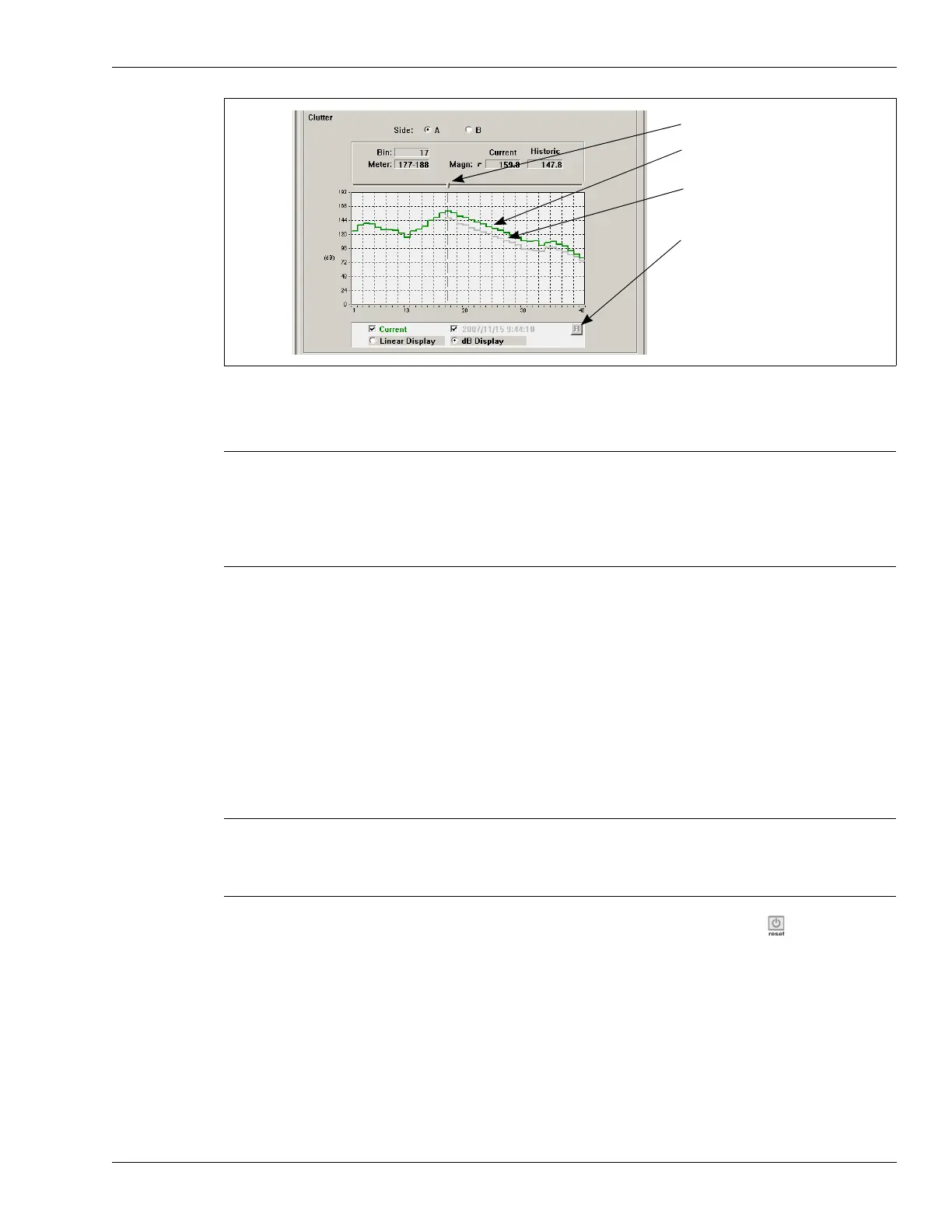
1. To save the current clutter level as the historic clutter level select the reset button located
below the clutter display.
The historic clutter is then displayed as a gray line in the clutter window.
2. Save the UCM configuration file and download the configuration changes to the processor.
Figure 191: OmniTrax clutter display
Note The Historic clutter level is used by all types of OmniTrax cable
supervision. When you first setup and calibrate the OmniTrax
processor, save a UCM file, which includes the original level of clutter.
In addition, use the Reset button regularly to reset the historic clutter
level to prevent cable supervision alarms from being caused by slowly
changing ground conditions.
Note Senstar recommends using the default historic variance parameter of
12 dB. Change the historic variance parameter only if cable supervision
alarms are being caused by large objects such as vehicles crossing, or
parking near, the sensor cables or environmental effects.
slider control
current clutter display
(green line)
historical clutter display
(gray line)
reset button
select the reset button to
set the current level of
clutter as the historical
clutter record


 To Next Page