Residential & commercial applications
OmniTrax Product Guide Page 81
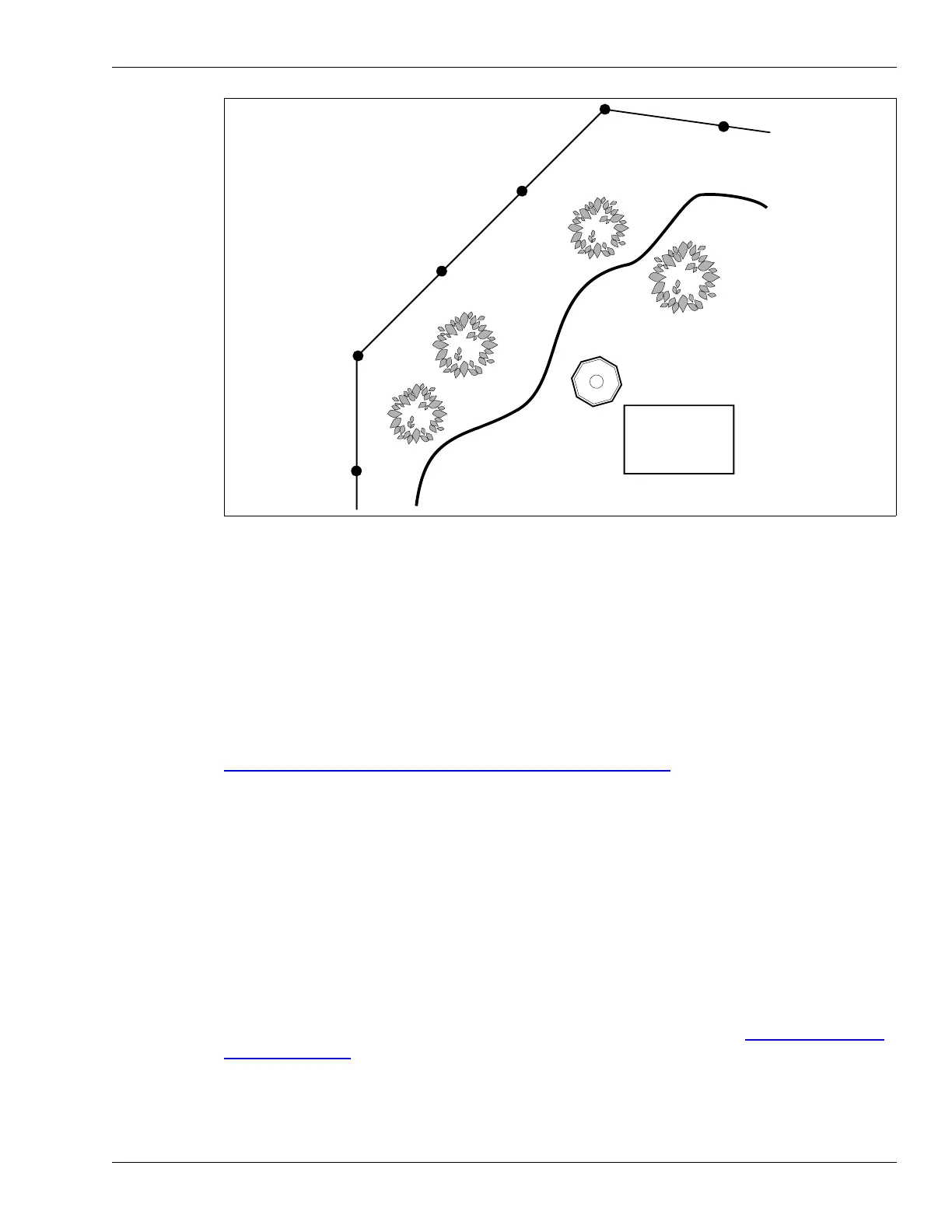
The OmniTrax sensor cable can be adapted easily to corners and grade changes allowing the
system to be installed around bushes, full-sized trees, and man-made obstacles. The covert
nature of the system hides the location of the detection zone. A meandering cable path can be
regarded as an advantage, as even an informed intruder cannot predict the exact location of the
detection field.
Buried water pipe and electrical cable avoidance
Where possible, the sensor cable path should avoid irrigation pipes or electrical cables (see
Separation distances from pipes, conduits and cables
on page 42). By working with the landscape
planner prior to the layout of the irrigation pipes and control cables, the OmniTrax sensor cable
can be afforded a reasonably clear path without compromising the irrigation coverage. Avoid
running sensor cables parallel to irrigation pipes and across sprinkler pipes as much as possible. If
this is not possible, the pipes must be shielded to prevent the detection field from “sensing” the
moving water. When the pipe crosses above or below the cable, it must be wrapped, in metal foil
specified for direct burial, for a distance of approximately 1 m (3 ft., 3 in.) on both sides of the
sensor cable. Parallel running pipes which are within 30 cm (12 in.) of the sensor cables should
also be shielded.
Protection against gardening and landscaping damage
Protection of the sensor cable against damage from landscaping activities throughout the life-span
of the system is an important factor in maintaining proper performance (see Protection of buried
cables on page 37). Where there will be no further landscaping activities and minimal surface
maintenance the recommended burial depth of 23 cm (9 in.) will provide adequate long term
protection. However, in areas where planting will be an on-going activity, or where future irrigation
changes are anticipated, the sensor cable should be protected with some form of non-metal barrier
such as pressure treated wood or PVC conduit cut lengthwise in a half-circle.
Figure 47: Adapting the sensor cable path to the environment
narrow cable spacing
single trench installation
building
security fence
water fountain
tree


 To Next Page