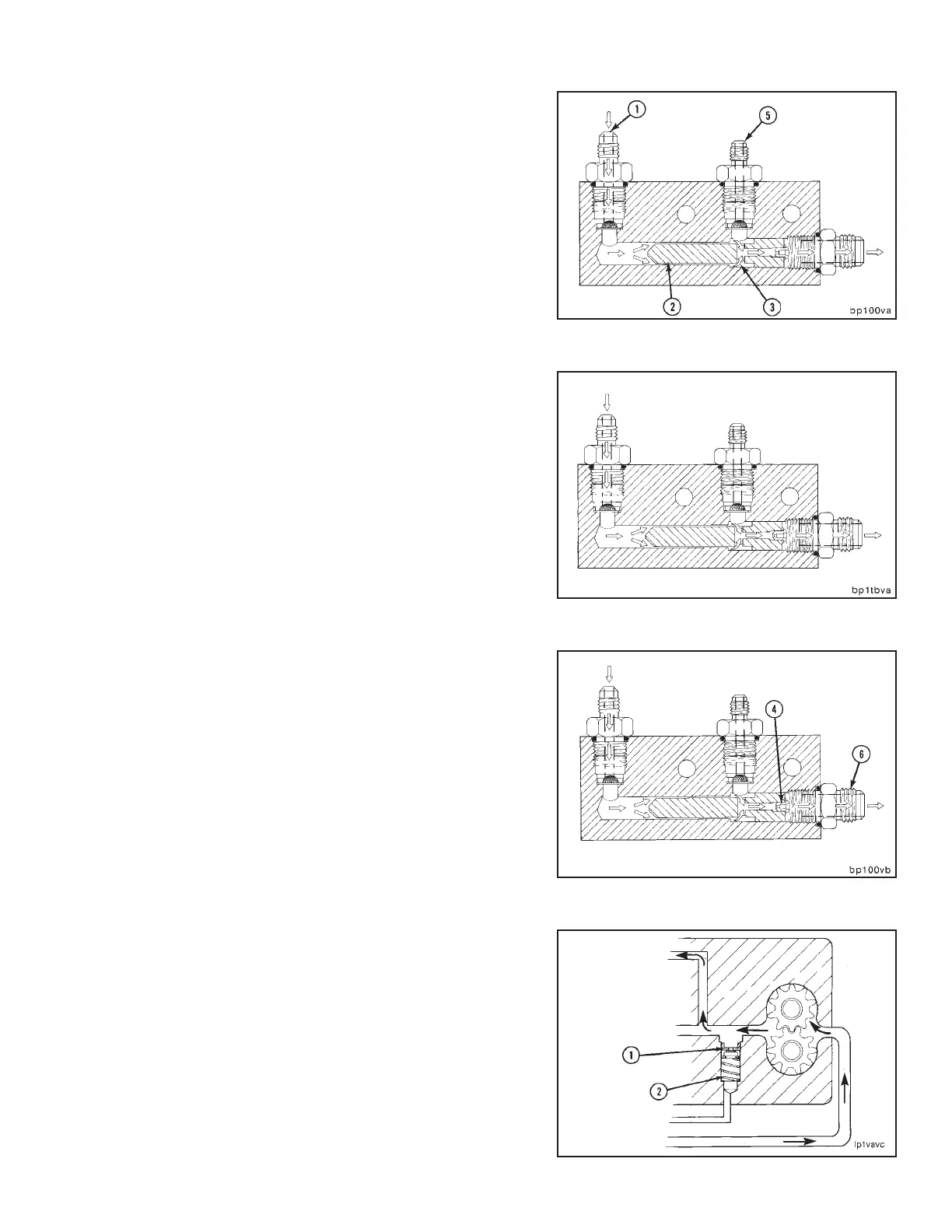
Oil from the oil rifle (1) enters the viscosity sensor and
flows through the long annular area (2). When the oil is
cold, there is a very high pressure drop from the oil rifle
to the undercut area (3). Due to this pressure drop, the
lubricating pump regulator (5) ‘‘sees’’ a pressure in the
undercut area lower than oil rifle pressure. Therefore, a
higher than normal oil rifle pressure is required to achieve
the normal lubricating pump regulator line pressure (ap-
proximately 275 kPa [40 psi]).
When oil temperature increases, the viscosity of the oil
decreases allowing it to pass through the annular area
easier. The pressure drop from the oil rifle to the undercut
area is almost zero. The lubricating pump regulator
‘‘sees’’ a pressure in the undercut area the same as oil
rifle pressure. Therefore, an increase in oil rifle pressure
is no longer required to achieve normal lubricating pump
regulator line pressure. The lubricating pump delivers
normal pressure to the oil rifle, while receiving a normal
regulator pressure signal.
The orifice (4) also helps to increase the oil rifle pressure,
when the oil is cold, by bleeding off some of the flow in
the undercut area. If the orifice is too small, the viscosity
sensor is effectively eliminated from the system and acts
as a lubricating pump signal line. If the orifice is too large,
it will bleed an unacceptable amount of the system’s
capacity off to the drain (6) to the oil sump pan, reducing
the available oil flow for lubrication. If the orifice is too
large, it will also bleed off too much flow from the undercut
area. This causes the lubricating pump to deliver high oil
pressure even under warm oil temperatures. This can
decrease the life of the lubricating pump.
Lubricating Oil Pump High Pressure Limit
Valve
The high pressure limit valve (1) is held in the closed
position by spring force (2). The valve remains in the
closed position until the oil pressure exceeds 862 kPa
[125 psi] in the lubricating oil pump.
Section 2 - Lubricating System Lubricating System General Information
N14 Page 2-5



 To Next Page