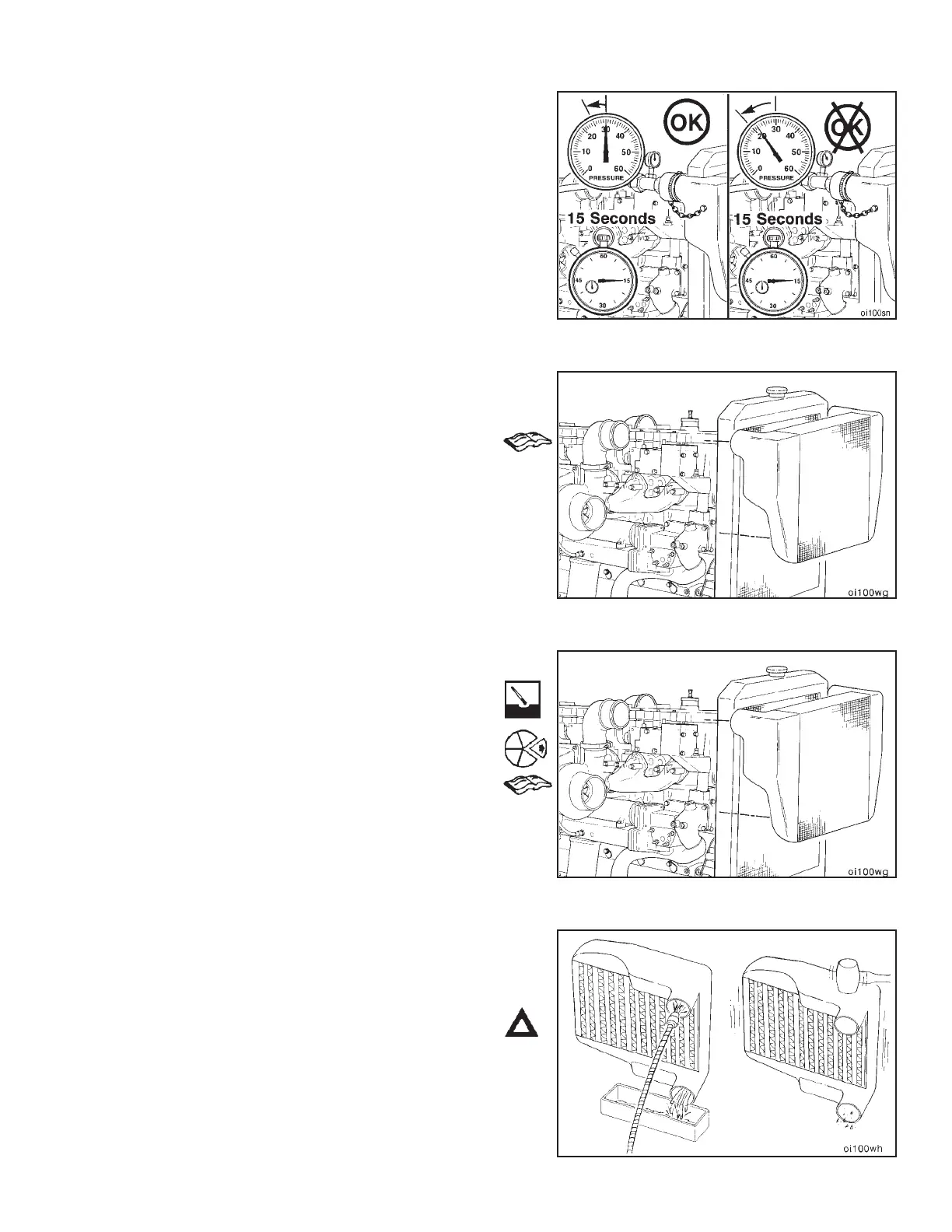
If the pressure decay is caused by a leaky connection,
repair the connection and repeat the test. If the leak is
within the CAC, repeat the test to verify the accuracy of
the pressure decay measurement. Similar pressure de-
cay readings must be obtained at least three consecutive
tests before the reading can be considered accurate.
NOTE: If a CAC leaks more than 49 kPa [7 psi] in 15 sec-
onds, it will appear as a major leak in a leak tank.
If the pressure drop is greater than 49 kPa [7 psi] in 15
seconds, the CAC must be replaced or repaired. Re-
placement is the preferred repair.
Refer to the manufacturer’s repair manual for repair
instructions.
Cleaning and Inspection
If the engine experiences a turbocharger failure or any
other occasion where oil or debris is put into the CAC, the
CAC must be cleaned.
Remove the CAC from the vehicle. Refer to the vehicle
manufacturer’s instructions.
Flush the CAC internally with solvent in the opposite
direction of normal air flow. Shake the CAC and lightly tap
on the end tanks with a rubber mallet to dislodge trapped
debris. Continue flushing until all debris or oil is removed.
Caution: Do not use caustic cleaners to clean the CAC.
Damage to the CAC will result.
Section 3 - Combustion Air System Charge Air Cooler (3-11)
N14 Page 3-31



 To Next Page