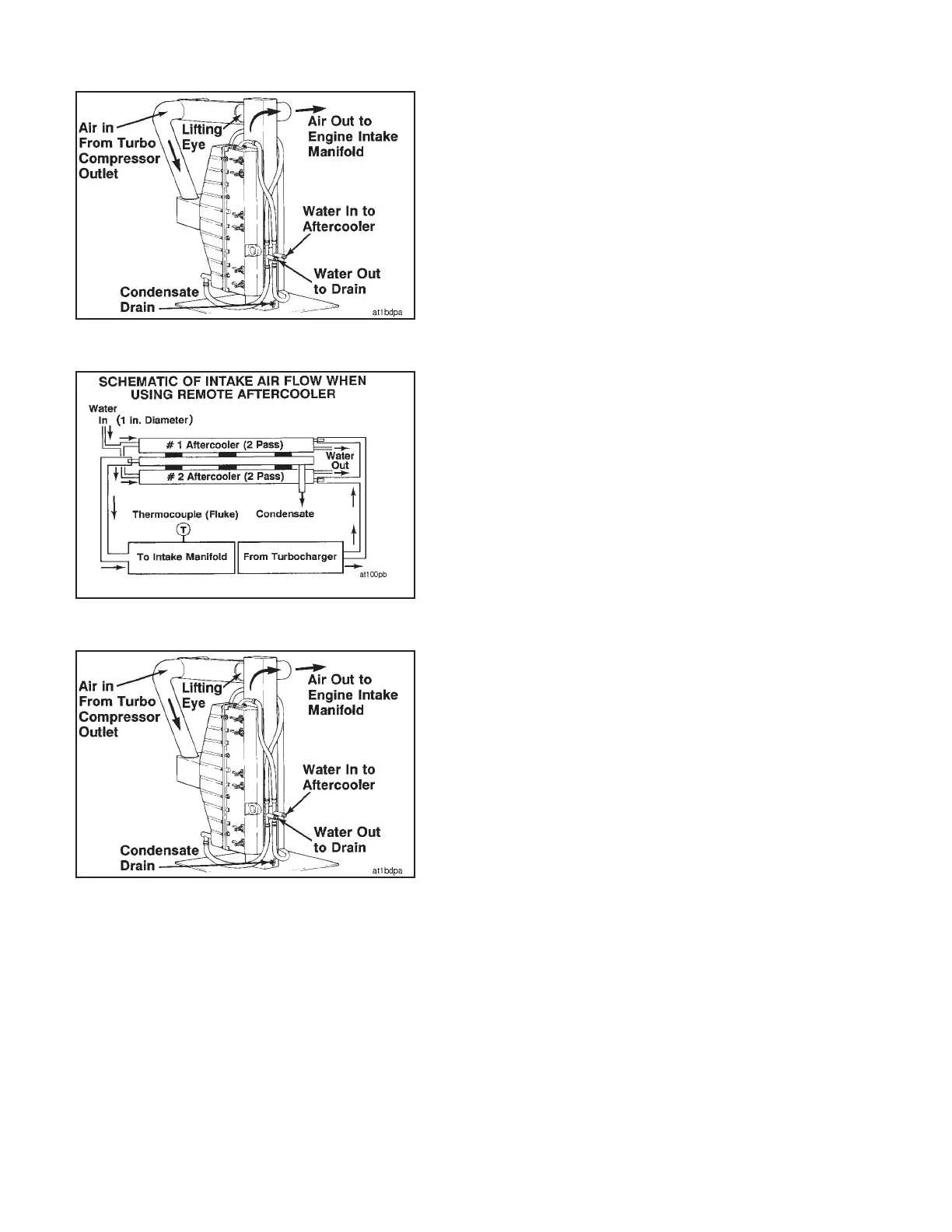
Intake Air Temperature Control
The use of a remote aftercooler is mandatory whenever
a Cummins CAC engine is attached to an engine dyna-
mometer for the purpose of engine run-in, performance
testing and engine diagnostics. Do not attempt to run a
Cummins CAC engine without any means of controlling
the intake manifold air temperature. Service tool, Part No.
3823978, utilizes twin Big Cam III aftercooler assemblies
arranged for parallel air and water flow to cool the intake
air to acceptable levels.
The parallel air flow circuit heat exchangers provide op-
timum performance by delivering air to the intake man-
ifold at temperatures no higher than 66°C [150°F], and
with less than the maximum allowable intake air pressure
drop (102 mm Hg [4 in Hg]).
The remote aftercooler removes energy from the intake
air which is compressed and heated by the turbocharger
to temperatures as high as 210°C [410°F] then cooled to
temperatures of 66°C [150°F] using city water at 16°C
[60°F].
Water from a city tap line flows to the aftercoolers via a
one inch I.D. neoprene hose. Testing has shown the 12
GPM city water flow is required (6 GPM per aftercooler
core) to adequately cool the intake air for the N14 460E
engine. A typical garden hose is not suitable for this flow
due to the excessive restriction. A low restriction ball type
or gate valve is suitable for the operation provided the
required flow rates are obtained.
Water returns to the drain or reservoir from the after-
coolers via a one inch I.D. hose. A low restriction gate
valve or ball valve must be placed on the drain line(s) to
allow regulation of the water flow through the aftercoolers.
This enables one to maintain optimum intake air tem-
perature during the test or run-in procedure.
The condensate that will develop, as the intake air is
cooled in the remote aftercooler, is allowed to drain at all
times through a hole at the bottom of the tubular steel
manifold between the aftercoolers. This fitting must re-
main unobstructed throughout each use of the after-
coolers.
NOTE: Some air flow will escape through the condensate
drain opening, but it is insignificant compared to the total air
flow.
Engine Dynamometer - Install Engine (8-01) Engine Testing
N14Page 8-10



 To Next Page