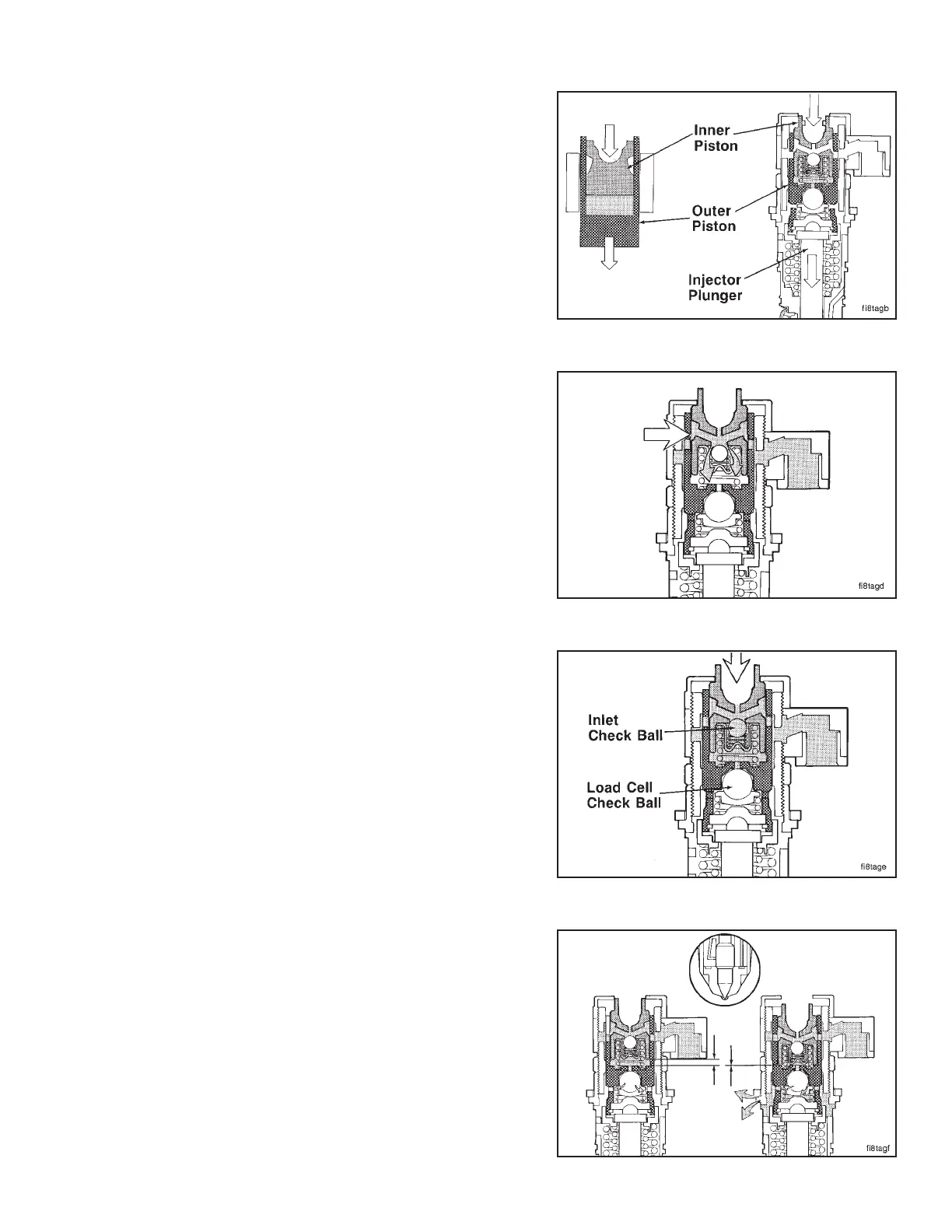
In ADVANCED timing, the tappet is filled with oil as the
injector is metering fuel. As the camfollower starts up the
cam injection ramp, the injector lever begins to force the
inner piston downward. Since the oil between the pistons
forms a solid link, the downward pressure is immediately
transmitted to the outer piston, and the injector plunger
begins its downward travel earlier than it does in NOR-
MAL timing. This causes the fuel to be injected earlier.
Engine oil flows from the STC oil control valve through the
oil manifold to the tappets. Whenever the oil pressure to
the tappet exceeds 70 to 83 kPa [10 to 12 psi], it moves
the tappet inlet check ball from its seat, and fills the cavity
between the inner and outer pistons.
During the injection cycle, the oil is held inside the tappet
by the inlet check ball and the load cell check ball. When
the rocker lever forces the inner piston downward, the
solid link of oil causes the injector plunger to contact the
fuel earlier; therefore, the injection timing is in the AD-
VANCED mode. At the end of the injection cycle, injection
force increases the oil pressure in the tappet and holds
the injector plunger firmly in the cup.
This increased pressure moves the load cell check ball
from its seat. The oil drains past the load cell check ball
and through the drain holes in the injector adapter, and
returns to the oil pan through drain passages in the cyl-
inder head and block. Meanwhile, with continued cam lift,
the inner piston makes mechanical contact with the outer
piston and maintains injector plunger seating force.
Section 5 - Fuel System Fuel System General Information
N14 Page 5-9



 To Next Page