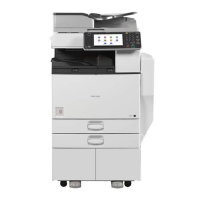
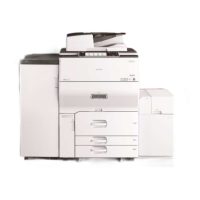
• The machine has three built-in paper trays:
• Tandem LCT (Tray 1). 1550 + 1550 sheets
• Universal Tray (Tray 2) 550 sheets
• Universal Tray (Tray 3) 550 sheets
Built-in Feed Stations
• Paper feed and separation. Standard FRR system with a torque limiter for paper separation and feed.
Each tray has an independent stepper motor to drive its paper feed mechanisms.
Handling Paper> Paper Feed Methods> Forward and Reverse Roller (FRR)
• Tray Lift motors. Provided for each tray, easily disengage when a tray is removed and engage once
again when the tray is re-installed. In trays 2 and 3, the lift of the motors on the bottom plates is also
used for paper near-end detection.
• Tandem tray paper end. A sensor mounted near the top of the right rail signals paper near end and
another sensor under the bottom tray signals paper end after the last sheet is fed. Three paper height
sensors, mounted on the left rail, are actuated as the actuator rises with the bottom plate. The com-
binations of actuating and de-actuating these sensors as the plate rises are used to signal the paper
supply display on the operation panel.
• Paper size detection. For the tandem tray (Tray 1), an SP setting is required (SP 5959 001). For the
universal trays (Tray 2, 3), there is a 5-step manual switch on each tray.
• Vertical Transport. A grip roller at each feed station feeds the paper into the vertical paper path.
• Heaters. Two anti-condensation heaters are provided for the built-in paper feed stations.
Paper Registration
• Paper is guided to the registration roller from four sources: the 3 built-in paper trays and 1 duplex
tray.
• There is a mylar strip over the entire length of the registration roller.
Jam Removal
Pulling out a paper tray releases the pressure on the rollers, making it easy to remove paper jams.
Paper Feed
481



 To Next Page