7.35
Date Code 20150130 Instruction Manual SEL-787 Relay
Communications
SEL ASCII Protocol and Commands
QUIT Command
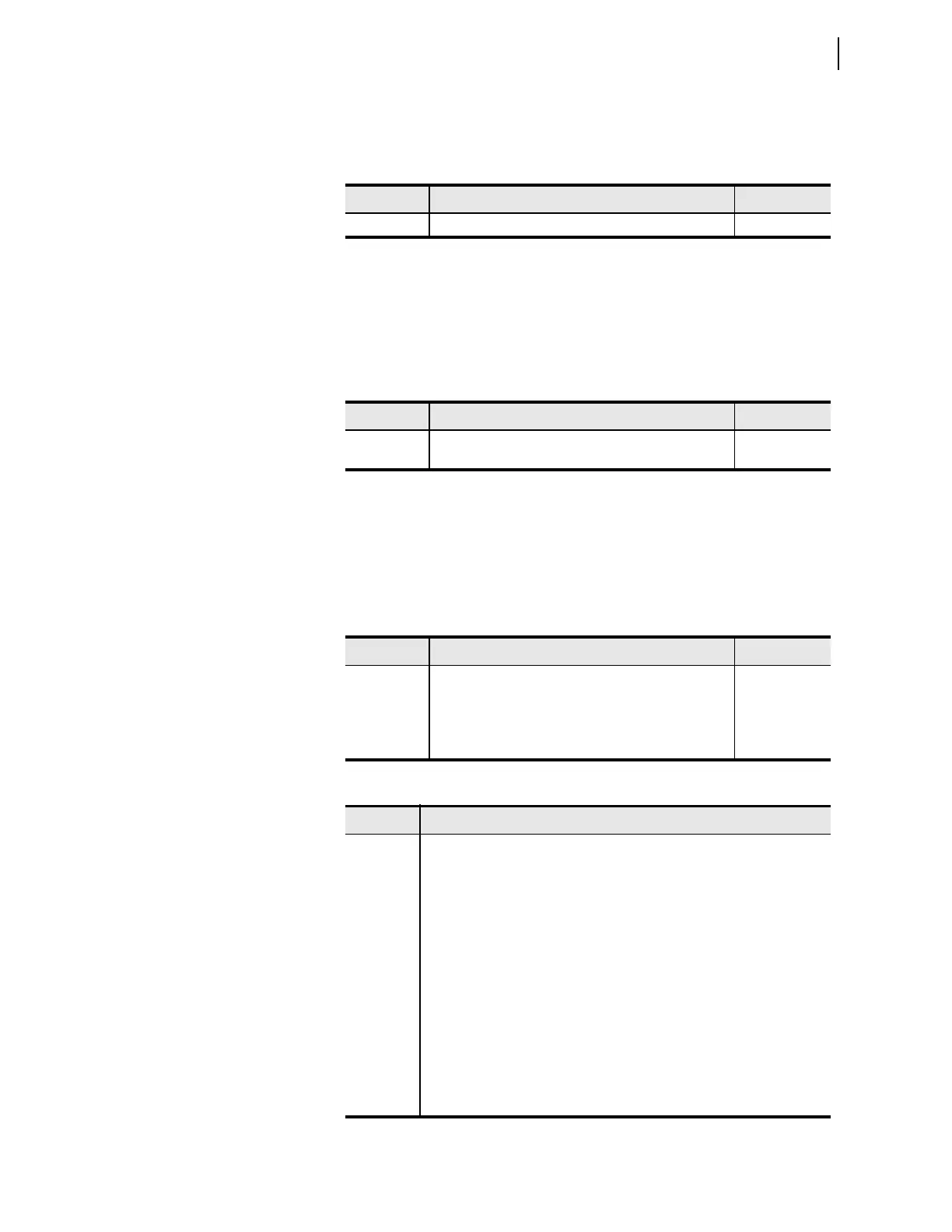
Use the QUIT command (see Table 7.37) to revert to Access Level 0.
Access Level 0 is the lowest access level; the SEL-787 performs no password
check to descend to this level (or to remain at this level).
R_S Command (Restore Factory Defaults)
Use the R_S command (see Table 7.38) to restore factory-default settings.
SER Command (Sequential Events Recorder Report)
Use the SER commands (see Table 7.39 and Table 7.40) to view and manage
the Sequential Events Recorder report. See Section 9: Analyzing Events for
further details on SER reports.
Table 7.37 QUIT Command
Command Description Access Level
QUIT Go to Access Level 0. 0
Table 7. 38 R _ S Command (Resto re Fa c tory Defa u lts)
Command Description Access Level
R_S Restore the factory-default settings and passwords, and
reboot the system.
a
a
Only available after a settings or critical RAM failure.
2
Table 7.39 SER Command (Sequential Events Recorder Report)
Command Description Access Level
SER Use the SER command to display a chronological
progression of all available SER rows (as many as
1024 rows). Row 1 is the most recently triggered row,
and row 1024 is the oldest.
1
SER C or R Use this command to clear/reset the SER records. 1
Table 7.40 SER Command Format
Parameter Description
row1 Append row1 to return a chronological progression of the first
row1 rows. For example, use SER 5 to return the first five rows.
row1 row2 Append row1 and row2 to return all rows between row1 and
row2, beginning with row1 and ending with row2. Enter the smaller
number first to display a numeric progression of rows through the report.
Enter the larger number first to display a reverse numeric progression of
rows. For example, use SER 1 10 to return the first 10 rows in numeric
order or SER 10 1 to return these same items in reverse numeric order.
date1 Append date1 to return all rows with this date. For example, use SER
1/1/2008 to return all records for January 1, 2008.
date1 date2 Append date1 and date2 to return all rows between date1 and date
beginning with date1 and ending with date2. Enter the oldest date first to
display a chronological progression through the report. Enter the newest
date first to display a reverse chronological progression. Date entries are
dependent on the date format setting DATE_F. For example, use SER
1/5/2008 1/7/2008 to return all records for January 5, 6, and 7, 2008.



 To Next Page