F.9
Date Code 20150130 Instruction Manual SEL-787 Relay
IEC 61850 Communications
IEC 61850 Operation
Time Stamps and
Quality
In addition to the various data values, the two attributes quality and t (time
stamp) are available at any time. The time stamp is determined when data or
quality change is detected.
The timestamp is applied to all data and quality attributes (Boolean, Bstrings,
Analogs, etc.) in the same fashion when a data or quality change is detected.
However, there is a difference in how the change is detected between the
different attribute types. For points that are assigned as SER points, i.e.,
programmed in the SER report, the change is detected as the receipt of an SER
record (which contains the SER timestamp) within the relay.
For all other Booleans or Bstrings, the change is detected via the scanner,
which compares the last state against the previous state to detect the change.
For analogs, the scanner looks at the amount of change relative to the
deadband configured for the point to indicate a change and apply the
timestamp. In all cases, these timestamps are used for the reporting model.
Functionally Constrained Data Attributes mapped to points assigned to the
SER report have 4 ms SER-accurate timestamps for data change events. In
order to ensure that you will get SER-quality timestamps for changes to
certain points, you must include those points in the SER report. All other
FCDAs are scanned for data changes on a 1/2-second interval and have
1/2-second timestamp accuracy. See the SET R command for information on
programming the SER report.
The SEL-787 uses GOOSE quality attributes to indicate the quality of the data
in its transmitted GOOSE messages. Under normal conditions, all attributes
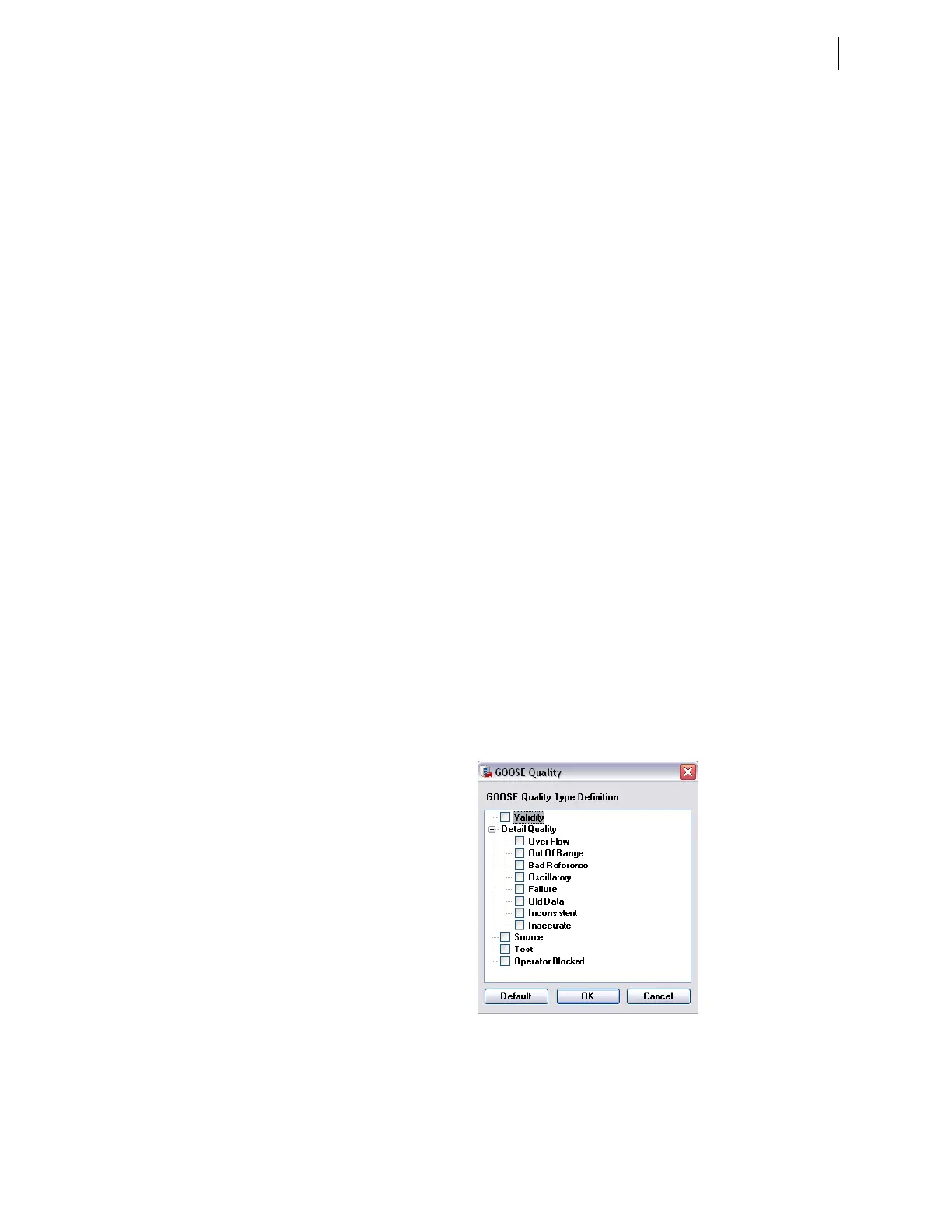
are zero, indicating good quality data. Figure F.3 shows the GOOSE quality
attributes available to devices that subscribe to GOOSE messages from
SEL-787 datasets that contain them. Internal status indicators provide the
information necessary for the device to set these attributes. For example, if the
device becomes disabled, as shown via status indications (e.g., an internal
self-test failure), the SEL-787 will set the Validity attribute to invalid and the
Failure attribute to TRUE. Note that the SEL-787 does not set any of the other
quality attributes. These attributes will always indicate FALSE (0). See the
ACSELERATOR Architect online help for additional information on GOOSE
quality attributes.
Figure F.3 Goose Quality



 To Next Page