Overview
X
TRA Operator’s Manual 20077/021 US 2-1
Chapter 2: Overview
Advantages of Intra- and Postoperative Red Cell Recovery
Although collecting and reinfusing a patient's own blood (referred to as autologous blood) has been
reported in the medical literature as far back as 1818, this procedure recently has gained renewed
interest due to the growing concern over the possibility of disease transmission via transfusions of
blood from a donor (referred to as homologous blood).
Intraoperative blood recovery offers significant advantages to the patient, surgical team, and hospital.
Clinical Applications
Autotransfusion (Intraoperative) processing is widely employed for cardiac and vascular surgery, but is
also suitable for other surgical procedures during which blood loss occurs.
Specialties employing this technology include orthopedics, plastic and reconstructive surgery,
neurosurgery, solid organ transplants, general surgery, gynecology, and trauma.
Specific clinical applications have included:
•Aneurysm repair
• Artero-venous malformation repair
• Valve replacements and coronary artery bypass grafts
• Primary and revision hip and knee arthroplasty, spinal repair, and Harrington rod procedures
• Ectopic pregnancies
• Major trauma such as penetrating chest and abdominal injuries including injuries to the liver,
spleen, chest wall, heart, pulmonary vessels, kidney, iliac vein, portal vein, and inferior vena cava
• Organ transplants
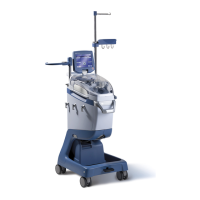
Description of the XTRA System
The XTRA System consists of a blood processing device, used in association with its disposable for
processing.
The X
TRA is available as an automated system or with any or all of the following programmable options
(discussed later in this chapter):
• Programmability (custom protocols)
• Emergency function
•X
VAC Vacuum System
• Preoperative Sequestration (automatic or manual)
• Data Management (USB, Printer, RS232)
• Quality Management (Built-in HCT Sampling System, built-in Waste Components Removal System)
The X
TRA has been designed with the operator in mind. To allow easy visualization of the system state
from across the room, the large touch screen control panel has colors identifying the current phase,
and its keys provide a two-way communication while guiding the user through the system's operation.





 To Next Page