C
HAPTER
4
| Configuring the Switch
Configuring the Spanning Tree Algorithm
– 136 –
start learning, predefining an alternate route that can be used when a node
or port fails, and retaining the forwarding database for ports insensitive to
changes in the tree structure when reconfiguration occurs.
MSTP – When using STP or RSTP, it may be difficult to maintain a stable
path between all VLAN members. Frequent changes in the tree structure
can easily isolate some of the group members. MSTP (which is based on
RSTP for fast convergence) is designed to support independent spanning
trees based on VLAN groups. Using multiple spanning trees can provide
multiple forwarding paths and enable load balancing. One or more VLANs
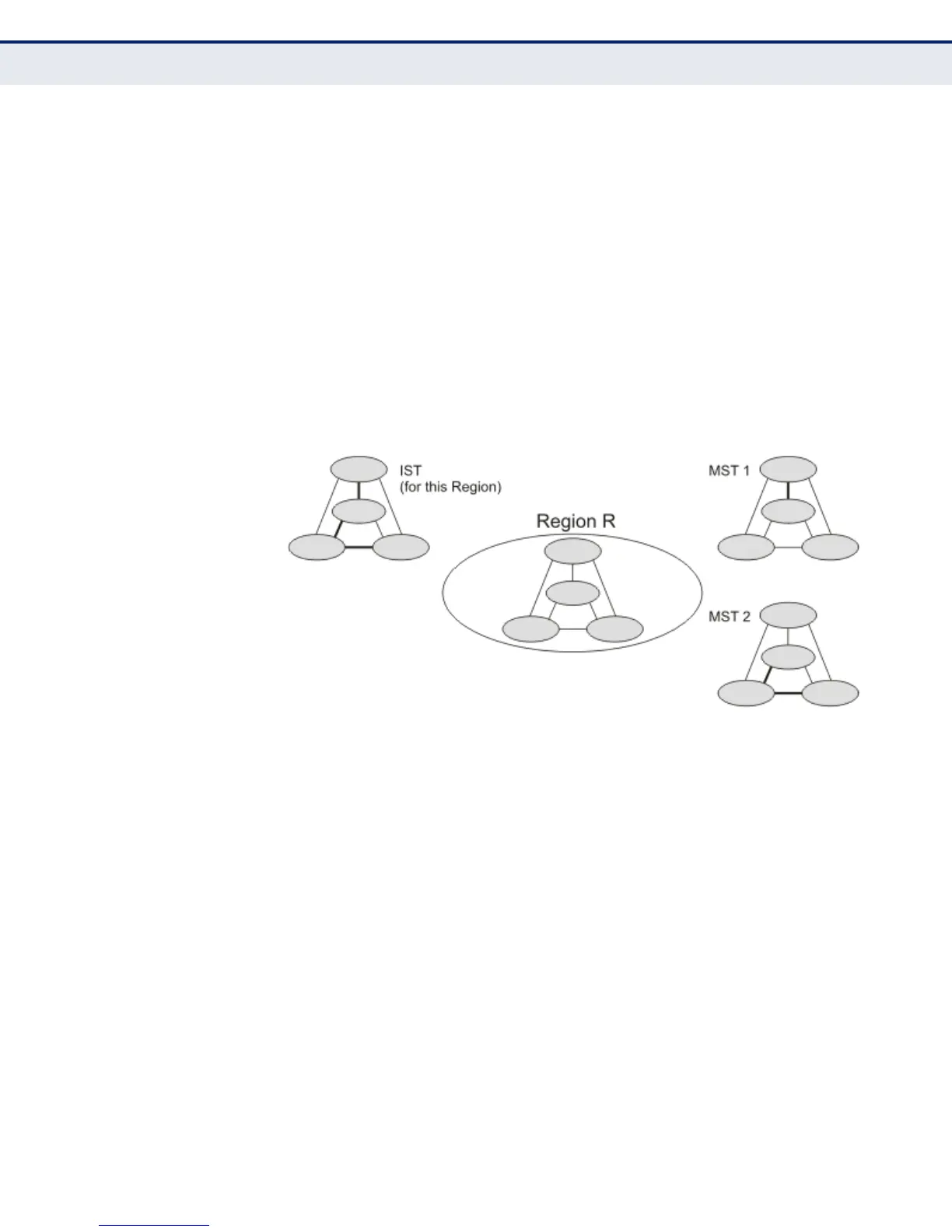
can be grouped into a Multiple Spanning Tree Instance (MSTI). MSTP builds
a separate Multiple Spanning Tree (MST) for each instance to maintain
connectivity among each of the assigned VLAN groups. MSTP then builds a
Internal Spanning Tree (IST) for the Region containing all commonly
configured MSTP bridges.
Figure 38: MSTP Region, Internal Spanning Tree, Multiple Spanning Tree
An MST Region consists of a group of interconnected bridges that have the
same MST Configuration Identifiers (including the Region Name, Revision
Level and Configuration Digest – see "Configuring Multiple Spanning Trees"
on page 140). An MST Region may contain multiple MSTP Instances. An
Internal Spanning Tree (IST) is used to connect all the MSTP switches
within an MST region. A Common Spanning Tree (CST) interconnects all
adjacent MST Regions, and acts as a virtual bridge node for
communications with STP or RSTP nodes in the global network.



 To Next Page