200
POWERHEAD
CYLINDER BLOCK CLEANING
CYLINDER BLOCK
CLEANING
IMPORTANT: Before inspecting or assembling
powerhead, all internal components must be com-
pletely clean and free of co ntaminants. Be careful
to avoid damaging any machined surfaces.
Remove any carbon accumula tion from e xhaust
port areas.
Remove any carbon accumulation from cylin der
head combustion chambers.
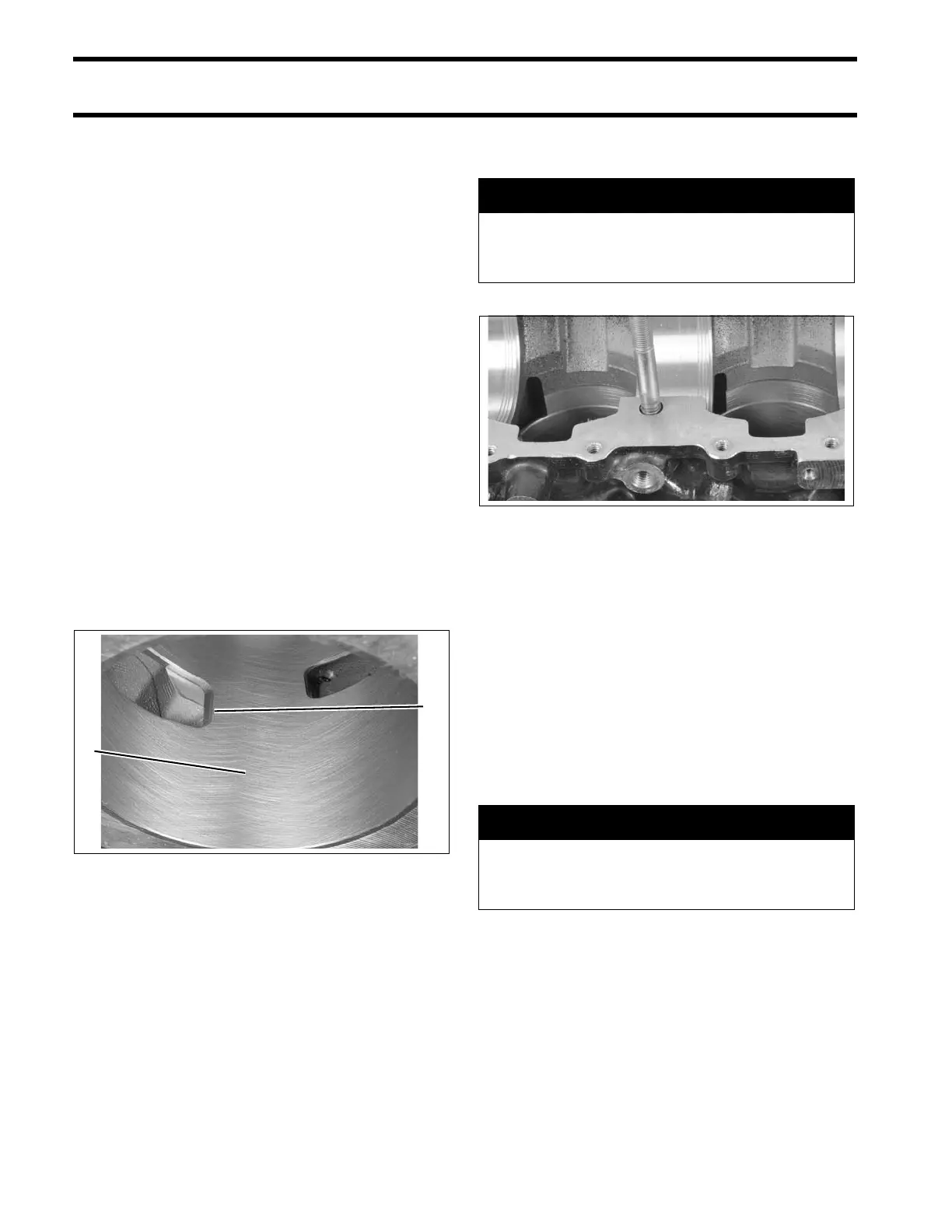
If cylinder walls are glazed from extende d use,
use a rigid, medium grit cylinder hone to resurface
walls. Use slow RPM for best oil retention and ring
sealing. W hen finished, a cro ss hatch p attern of
22 to 32° sh ould be visible in the cylinder wall.
The pattern should be uniform in both directions.
IMPORTANT: To avo id piston or cylind er block
damage, restore the chamfer to all port edge s
using a ball hone or other suitable tool.
Use Gel Seal and Gasket Remover to remove all
traces o f g askets, adhesives, and Gel-Seal II™
sealant from th e cylinder block, crankcase, cylin-
der head, and water cover.
Carefully rem ove an y carbon ac cumulation from
the tops and ring groo ves of the piston using
Engine Tuner. A ring groove cleaning tool can be
made by brea king an o ld ring and grind ing an
angle on it s end. Do not damage ring grooves
while cleaning.
Thoroughly wash en tire cylinder block and crank-
case with warm, soapy water to remove all traces
of contaminants.
Air dry cylind er block and crankcase. Blow all
holes and passageways with compressed air.
Cover the cylinder walls with a libera l amount of
outboard lubricant to prevent corrosion.
1. Crosshatch pattern in cylinder wall
2. Chamfered port edge
002067
A WARNING
To avoid personal injury, wear eye protec-
tion and rubber gloves when using Gel
Seal and Gasket Remover.
002068
A WARNING
To avoid personal injury, wear eye protec-
tion and set compressed air pressure at
less than 25 psi (172 kPa).




 To Next Page