144
Installation
8.3.8.4
AIR-TIGHTNESS TEST
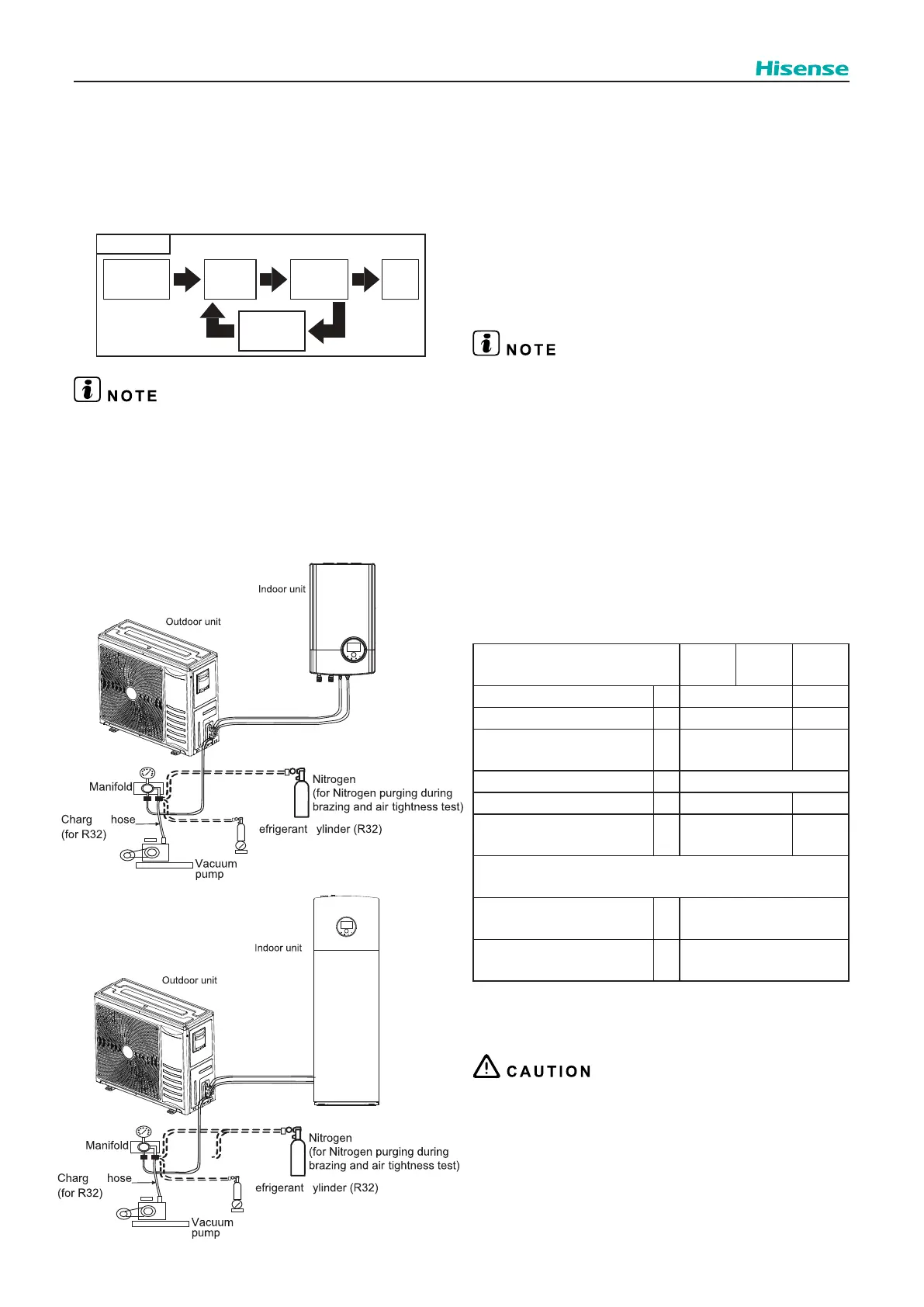
1. Connect the manifold gauge using charging hoses with a
nitrogen cylinder to the check joint of the gas stop valve.
Apply nitrogen gas pressure of 4.15MPa.
2.
or brazed parts by gas leak detector or foaming agent.
3. After the air-tightness test, release nitrogen gas.
Completion
of Ref.
Piping
Repairing
of Leakage
Part
Check of
Pressure
Decrease
Applying
Nitrogen
Gas
Pass
Procedure
Do not open the stop valves during the air-tightness test.
8.3.8.5
VACUUM PUMPING AND REFRIGERANT CHARGE
1. Connect the manifold gauge using charging hoses with a
vacuum pump to the check joint of the gas stop valve.
2. Continue vacuum pumping work until the pressure
reaches -0.1MPa or lower for one to two hours.
ing
gauge
cylinder
-
R c
Weighing scale
3. After vacuum pumping work, stop the manifold gauge’s
valve, stop the vacuum pump and leave it for one
hour. Check to ensure that the pressure in the manifold
gauge does not increase.
4. Fully open the gas stop valve and liquid stop valve.
5. Add refrigerant according to the piping diameter and
6. Check for any gas leakage by gas leak detector or
foaming agent. Use the foaming agent which does not
generate NH3 by chemical reaction.
When the spindle cap for stop valve is removed, the gas
accumulated at O-ring or screws is released and may make
sound. This phenomenon is NOT a gas leakage.
This unit is only for the refrigerant R32. The manifold gauge
and the charging hose should be exclusive use for R32.
If vacuum degree of -0.1MPa is not available, it may be
because of gas leakage or entering moisture. Check for any
gas leakage once again. If no leakage exists, operate the
vacuum pump for more than one to two hours.
8.3.8.6
REFRIGERANT CHARGING QUANTITY
In case of the total piping length(L) is more than the
charge-less piping length, the additional refrigerant quantity
should be charged according to the table below:
Capacity
44
(2.0HP)
60
(2.5HP)
80
(3.0HP)
Factory Charge kg 1.23 1.26
Charge-less piping length(L0) m 15 15
Additional charge for piping
length (L-L0)
g/m 20 30
Minimum piping length(Lmin) m 5
Maximum piping length(Lmax) m 40 45
Maximum total refrigerant
charge(*)
kg 1.73 2.16
indoor unit
Outdoor unit is higher than
indoor unit”
m 30
Indoor unit is higher than
outdoor unit
m 20
the following section).
When charging refrigerant, accurately measure refrigerant to
be charged.
compressor trouble.
ing
gauge
cylinder
-
R c
Weighing scale



 To Next Page